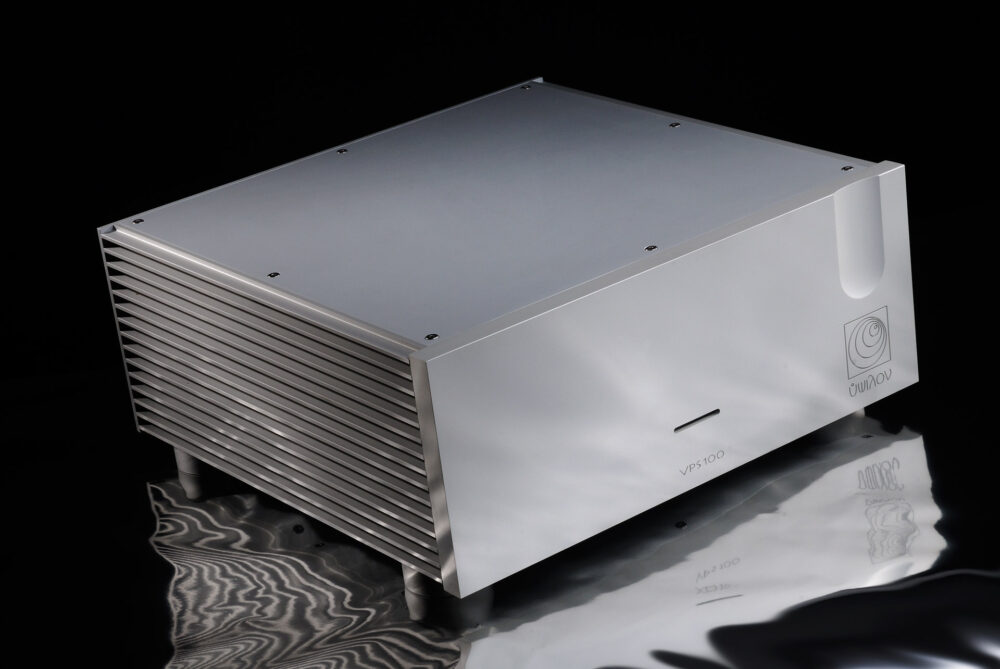
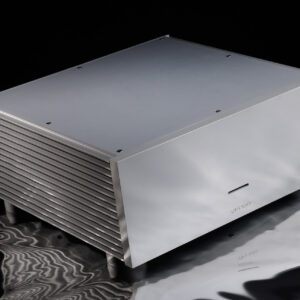
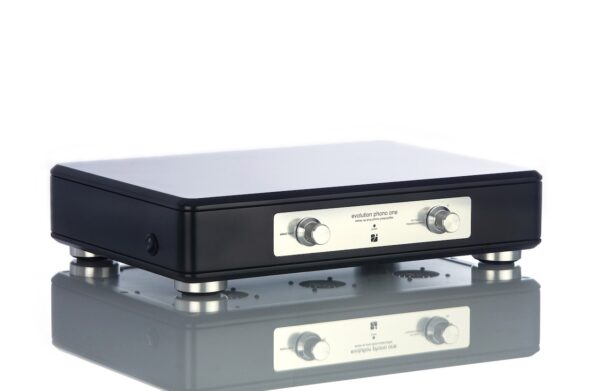
The Ypsilon VPS-100 MKII SE is the Silver Edition evolution of Ypsilon’s already legendary VPS-100 MKII phono stage. In the hierarchy of Ypsilon analog products, it sits alongside the PST-100 MKII SE as one of the company’s true statement-level components.
The road to VPS-100 took many turns in our long and extensive evaluation of topologies and materials, design and implementation.
Passive RIAA equalization is preferred to active because in active RIAA equalization there is a feedback loop and the RIAA network is in this feedback loop. Usually RIAA equalizer circuits are implemented with capacitors and resistors (CR networks). Capacitors present the so called “dielectric absorption” -energy is stored in the dielectric material and is added to the signal with a small delay producing a ringing character in fundamental notes. This ringing behavior can be noticed in piano notes. In the past an alternative way of implementing a RIAA equalizer the LCR (Inductance-capacitance-resistance) circuit was proposed.
A long time ago TANGO transformers from Japan used to produce such a circuit working in 600Ohms. A few manufacturers are using LCR based phono stages using variations of the original TANGO LCR circuit. The challenge in 600ohm LCR eq is to drive the network properly; having no more than 2 gain stages with enough overall gain and low enough output impedance.
The best way of driving the LCR network is by using a transformer. We design and build ourselves the transformers using a special amorphous c-core material. Winding insulation is paper. A properly implemented LCR RIAA sounds much more natural, musical and open than CR networks with better defined macro and micro dynamics.
The LCR networks most commonly used are based in double T filter networks .One T filter forms the 50-500Hz poles and the second T filter forms the 2123Hz pole.
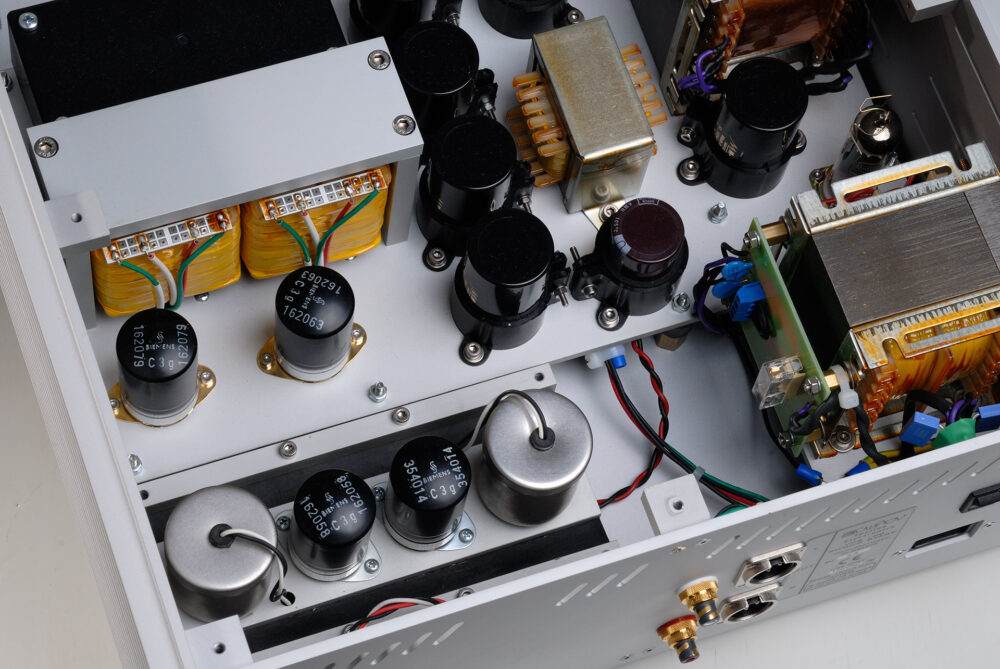
In the VPS-100 we took it one step further, the 2123Hz pole is formed by air core inductor with practically no stray capacitance at the first gain stage and the 50-500Hz poles are formed in high signal level directly at the output of the second gain stage. So this is a split RIAA design using two gain stages based on the SIEMENS C3g tube. These tubes are very reliable as they are specified for 10.000 hours.
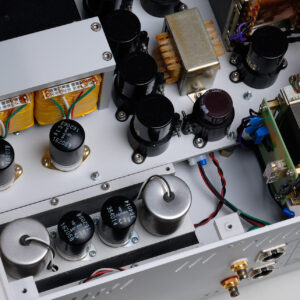
The power supply uses the 6CA4 tube rectifier and a choke filter .The heaters for the tubes are AC in the second stage and DC passive regulated for the first stage. The construction uses no printed circuit boards and is point to point silver wired using our own extruded and annealed to spec silver wire. Special attention is paid to mechanically de-couple the first gain stage and 2123 pole coils using a specially designed decoupling system. The rest of the construction is mounted on a aluminium sub chassis that forms together with the aluminium bottom plate a very rigid platform.
The Ypsilon VPS-100 Phono Stage is one of the most respected ultra-high-end phono preamplifiers ever produced and is often considered the analog counterpart to the PST-100 preamplifier. Designed entirely around Ypsilon’s transformer philosophy, it combines minimalist tube circuitry, LCR equalization, and proprietary transformers to achieve an exceptionally natural and holographic analog presentation.
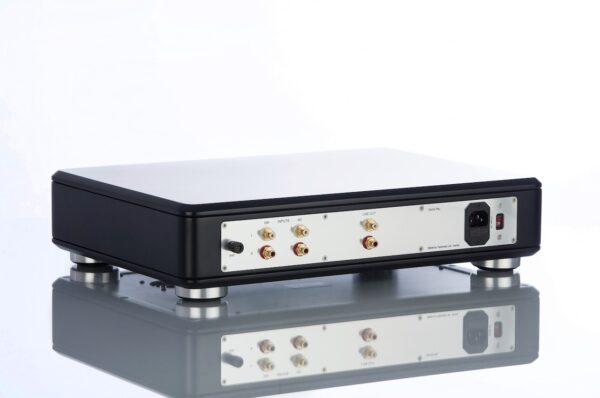
A particularly important aspect of the VPS-100 is that it is fundamentally a moving-magnet phono stage with approximately 39dB of gain. For moving-coil cartridges, Ypsilon strongly recommends pairing it with one of its external step-up transformers:
MC10
MC16
MC20
The Ypsilon VPS-100 MKII SE is the Silver Edition evolution of Ypsilon’s already legendary VPS-100 MKII phono stage. In the hierarchy of Ypsilon analog products, it sits alongside the PST-100 MKII SE as one of the company’s true statement-level components.
The Silver Edition pushes this concept substantially further through the extensive use of pure silver in critical signal-path components
Major SE upgrades include:
pure-silver internal wiring
custom silver-wound transformers
upgraded silver connectors
specially manufactured in-house magnetic components
further mechanical isolation and vibration control
Ypsilon’s philosophy is that transformer quality and conductor purity directly affect harmonic realism, timing, and spatial integrity. The SE version was created to minimize what the designers perceive as energy storage and phase-smearing artifacts common in conventional capacitor-based phono stages.
Sonically, the VPS-100 MKII SE is widely regarded as one of the most “live” and emotionally convincing phono stages ever built
SPECIFICATIONS VPS-100 PHONO STAGE
INPUT IMPEDANCE
47Kohm/200 pf
OUTPUT IMPEDANCE
1200 Ohm
OUTPUTS
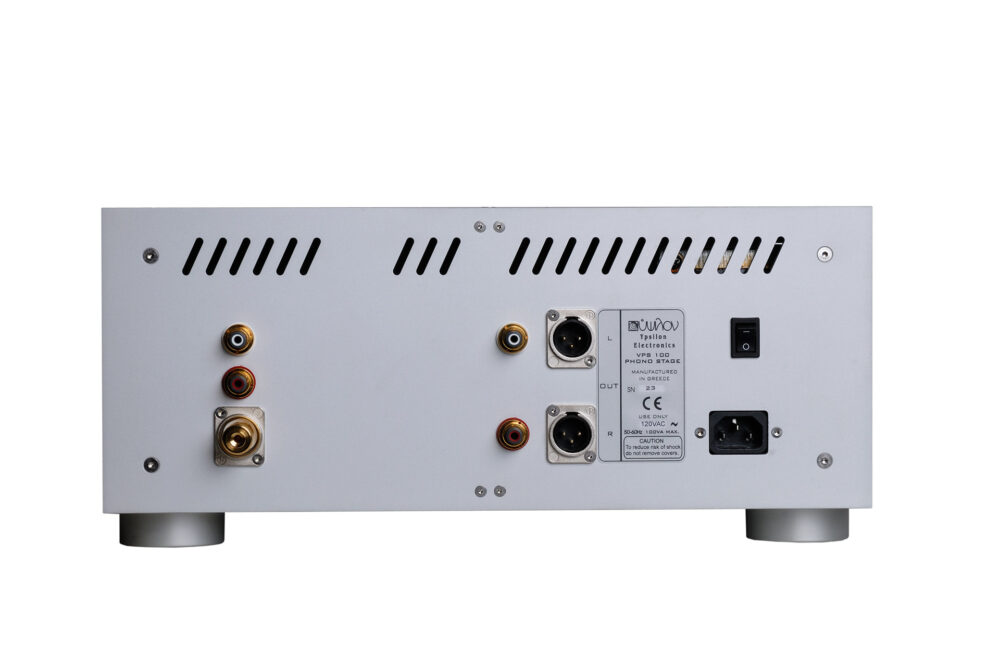
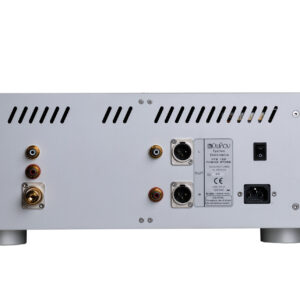
RCA unbalanced XLR unbalanced(pin1,3grounded)
FREQUENCY RESPONSE
-3db @ 10hz-40khz
MAXIMUM OUTPUT VOLTAGE
5 V peak @ 1Khz 50V peak @ 50Hz
RIAA ACCURACY
+/- 0,5 db 20hz-20khz
CHANNEL MIS MATCH
< 0,2 db
GAIN
39 db
POWER CONSUMPTION
Typically 20 W
DIMENSIONS
400x180x400 (WxHxD)mm
WEIGHT
25 Kgr
Reviews
There are no reviews yet.
Be the first to review “Ypsilon VPS-100 MkII Phono stage”Cancel Reply






Reviews
There are no reviews yet.