
- Home
- About us
- Blog
- Shop
- Brands
- ALL Brands List
- Ypsilon Electronics
- Analog Relax
- Antipodes Audio
- Audio Phase
- Audio Solutions
- AudioByte
- AudioCircle
- Audiomica Laboratory
- Canary Audio
- Canor Audio
- Chameleon Audio
- Dan D'agostino
- Diamond Sound
- Eversolo
- Ferrum Audio
- Fezz Audio
- Glanz
- HiFiMAN
- HoloAudio
- LAB 12
- LAIV
- LampizatOr
- Magico
- Mega Acoustic
- Monrio Audio
- Origin Live
- Phasemation
- Pink Faun
- PLiXIR
- Qualiton
- Reed
- Remton
- Revival Audio
- Riviera Audio
- Rockna Audio
- Sbooster
- Shelter
- Sigma Acoustics
- Signal Projects
- SOtM Audio
- SPEC
- Takatsuki
- Takumi
- Tellurium Q
- Trafomatic Audio
- Tsakiridis Devices
- Volumio
- Sales
- Second Hand Deals
- Account
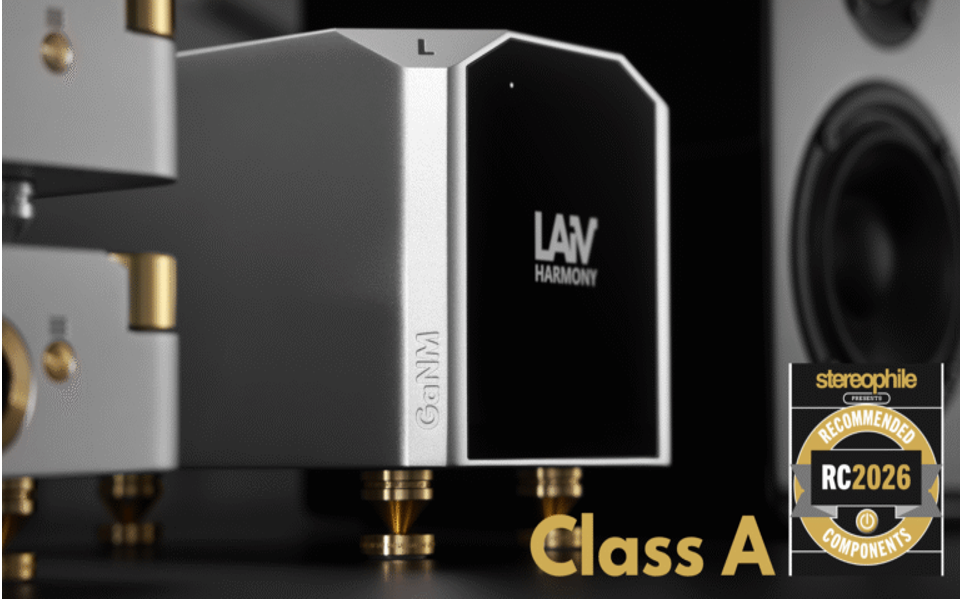
Laiv Harmony GaNM amplifiers Stereophile Class A
The LAiV Harmony GaNM monoblock
The first thing I noticed about the LAiV Audio GaNM monoblock amplifier ($4694/pair; footnote 1) is its unusual shape and size; it occupies space differently than the other, more basic amplifiers on my rack. The GaNMs sat there giving off a megalithic vibe. In either of their two finishes (silver and gold or black and gold), the solidity and seriousness of their sculptural form upstaged any glamor effects offered by their glossy OLED front panel, deeply engraved top-plate logo, and gold accents.
Opening a LAiV product box is a step-by-step graphically choreographed introduction to the company’s aesthetic and forward-thinking engineering perspective. When I reviewed LAiV’s Harmony µDAC in Stereophile‘s December 2025 issue, I was memorably impressed with the stylish intelligence of its packaging, but having now experienced unboxing the GaNM monoblocks, too, I understand better what LAiV is up to: They use their top-notch industrial design and smart product packaging like a smile and a handshake, greeting customers and helping them feel wise and safe for choosing the LAiV brand. Viewing their well-designed website has the same effect.
According to the specifications on that website, each GaNM monoblock delivers 200 class-D watts into 8 ohms (footnote 2). Each chassis measures just 4.7″ high, 5″ wide, and 10.2″ deep and weighs just 8.6lb. The only input is balanced (XLR) with a 94k ohm input impedance and a 1.4V sensitivity (for full output).
Gain is a highish 29dB. The power supply is a cool-running switching type, located inside the chassis (no wall wart). Its outputs feature high-quality binding posts that accept either spades or bananas.
The front-page news with the new LAiV monoblocks is gallium nitride FET transistors, used with no loop feedback. That’s why I decided to audition these mysterious monoblocks: I was curious about class-D without global feedback.Listening: The hardest part of making a painting is getting up out of the chair, walking over to the canvas, dipping a brush in paint, and making a mark. It’s the hardest part, yet any mark will do. That’s because, for me, it is just a “start mark.” Its job is to start flipping switches in my brain. Shutting off fear and vanity. The start mark initiates the closing of open thought windows, which continues until, free of distractions, my brain zones in and makes a second mark, followed by a thin wash and some charcoal lines. Then my mind’s all in.
I’m describing how my brain works for painting because something similar happens for listening. I am sitting here now locked on to the inner workings of Henry Purcell’s (1659–1695) King Arthur (extraits) played by the Deller Consort and Choir (HM E200). I am in awe of Purcell’s, Alfred Deller’s, and Harmonia Mundi France’s ability to create such a fantastic visual spectacle between my speakers and in my mind. For this “lock on” to occur, my brain had to flip those same switches and close those same distracting thought windows. And guess what? The hardest part was getting up and pulling out the record. The start mark was the sound of the diamond contacting the record’s surface. Soon after that, my mind was all in.The diamond that triggered this Henry Purcell start mark was attached to the Tzar Audio DST V1 Black Knight Corian moving coil cartridge into Lab12’s Melto2 phono amplifier into the HoloAudio Serene line-level preamp into LAiV Audio’s GaNM monoblock amplifiers driving my Falcon Gold Badge LS3/5a‘s. This component grouping showed me, in black and white, the singing faces of Deller’s consort and choir and their relative positions in the recording venue. The microphones were my surrogate eyes. Those singing faces and Purcell’s danceable tunes were a cheerful much-desired mood changer that kept my attention on the performances.
There was no blurring, hash, or uncertainty at the top or bottom of the Falcon’s passband. No grain or noise. Only pure sound.
Purcell’s most complex passages paraded through my room with a greater physicality and transparency but less color and sensuality than with the First Watt SIT-4.