
- Home
- About us
- Blog
- Shop
- Brands
- ALL Brands List
- Analog Relax
- Antipodes Audio
- Audio Phase
- Audio Solutions
- AudioByte
- AudioCircle
- Audiomica Laboratory
- Canary Audio
- Canor Audio
- Chameleon Audio
- Dan D'agostino
- Eversolo
- Ferrum Audio
- Fezz Audio
- Glanz
- HiFiMAN
- HoloAudio
- LAB 12
- LAIV
- LampizatOr
- Magico
- Mega Acoustic
- Monrio Audio
- Origin Live
- Phasemation
- Pink Faun
- PLiXIR
- Qualiton
- Reed
- Remton
- Revival Audio
- Riviera Audio
- Rockna Audio
- Sbooster
- Shelter
- Sigma Acoustics
- Signal Projects
- SOtM Audio
- SPEC
- Takatsuki
- Takumi
- Tedeska
- Tellurium Q
- Trafomatic Audio
- Tsakiridis Devices
- Volumio
- Sales
- Second Hand Deals
- Account
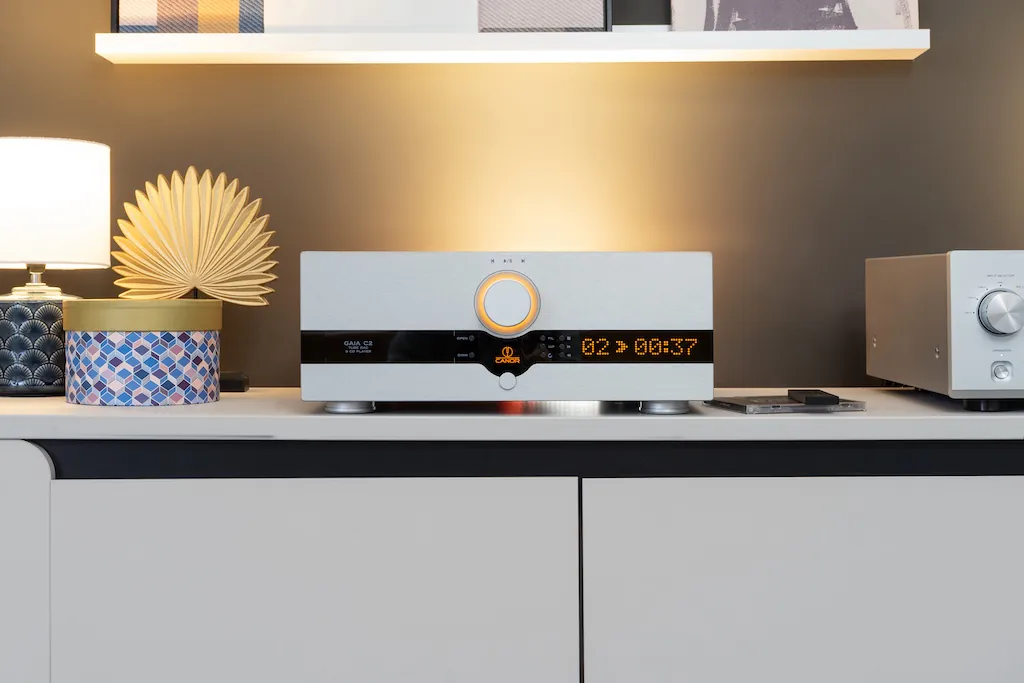
TEST: Canor Gaia C2 – New naturalness for HiRes and CD by Lite Magazine
Digital-to-analog conversion with a dual-mono design, passive filtering, and the use of tubes are intended to give the Canor Gaia C2 a particularly natural sound. The Slovakian company has also opted for a modern design, precise manufacturing, and extensive in-house expertise in its new DAC/CD player combination.
Until now, Canor’s DACs have always carried rather functional model names. Unlike their high-end amplifiers and phono stages, which are adorned with sonorous names like Hyperion, Virtus, or Asterion , the converters in the Performance Line were previously simply called DAC 2.10. For the latest addition to their Premium Line, however, the Slovakian manufacturer is now drawing on names from Greek mythology, christening the DAC and CD player combination the Gaia C2. This is a fitting choice, because just like Gaia, the primordial mother of the earth, Canor’s Hi-Res specialist is meant to prioritize naturalness. As expected, the power of tubes is relied upon, with five tubes of three different types being used. This sonic classic is then combined with two DAC chips, which convert the ones and zeros separately for each channel into the analog domain.
Modern style consciousness
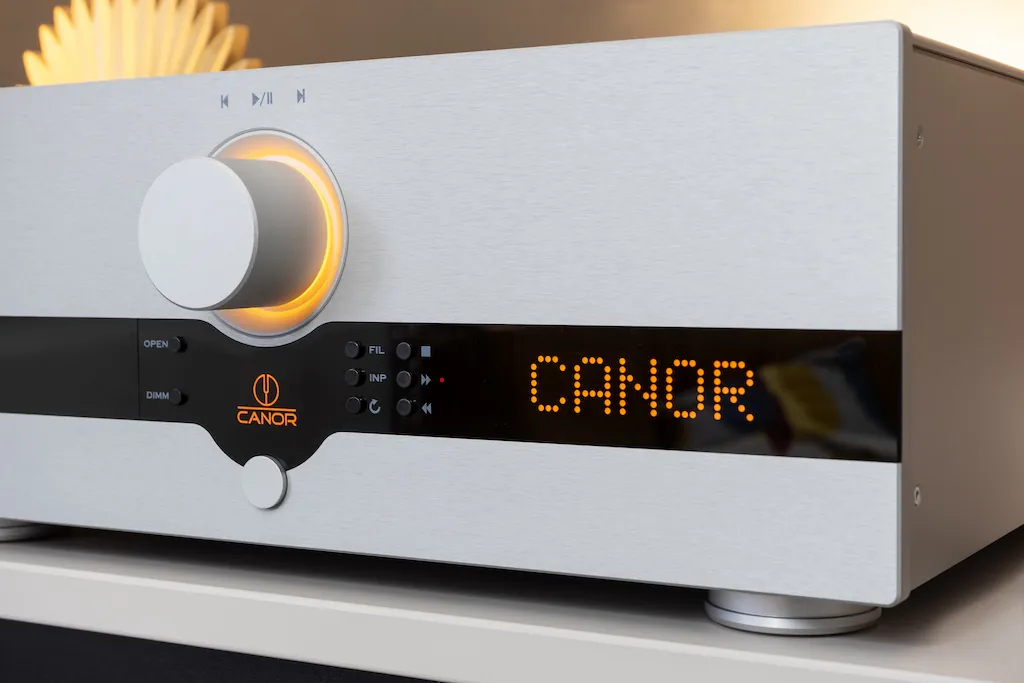
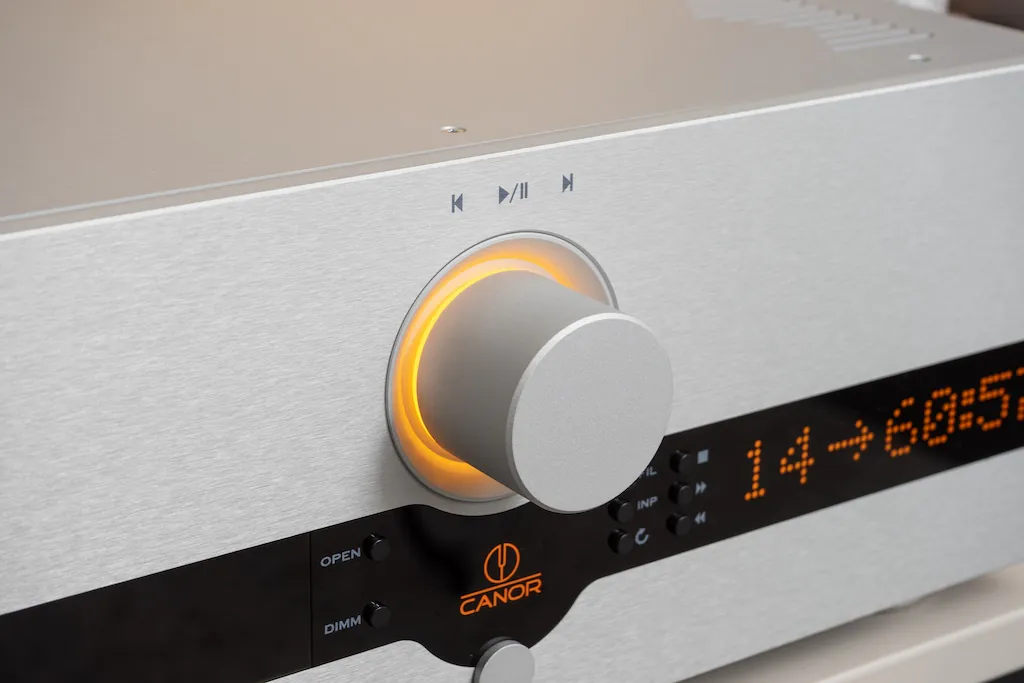
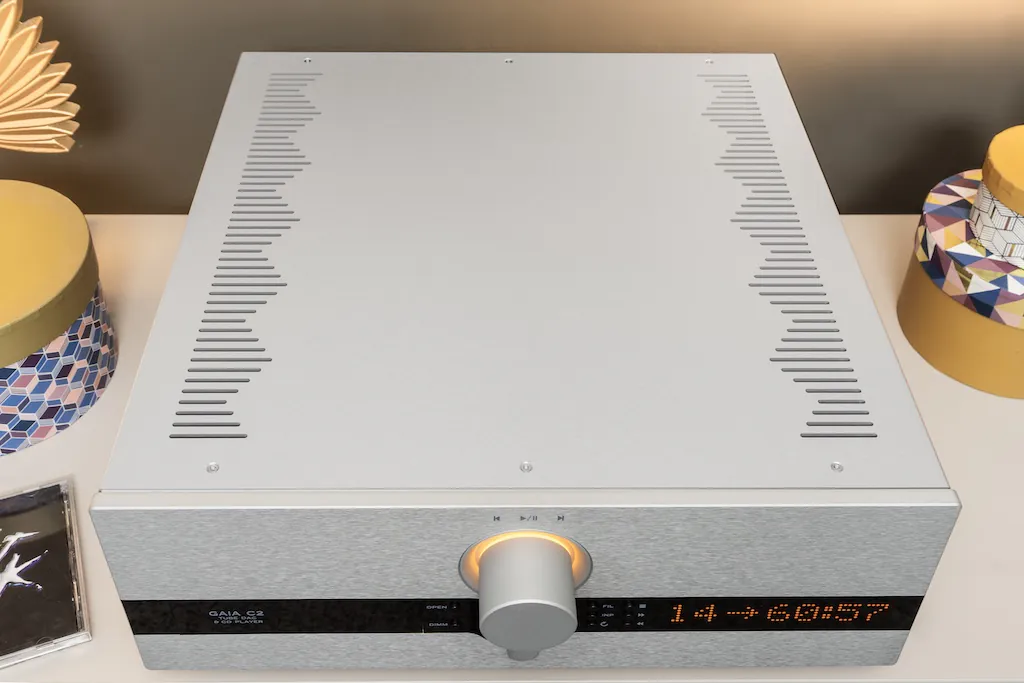
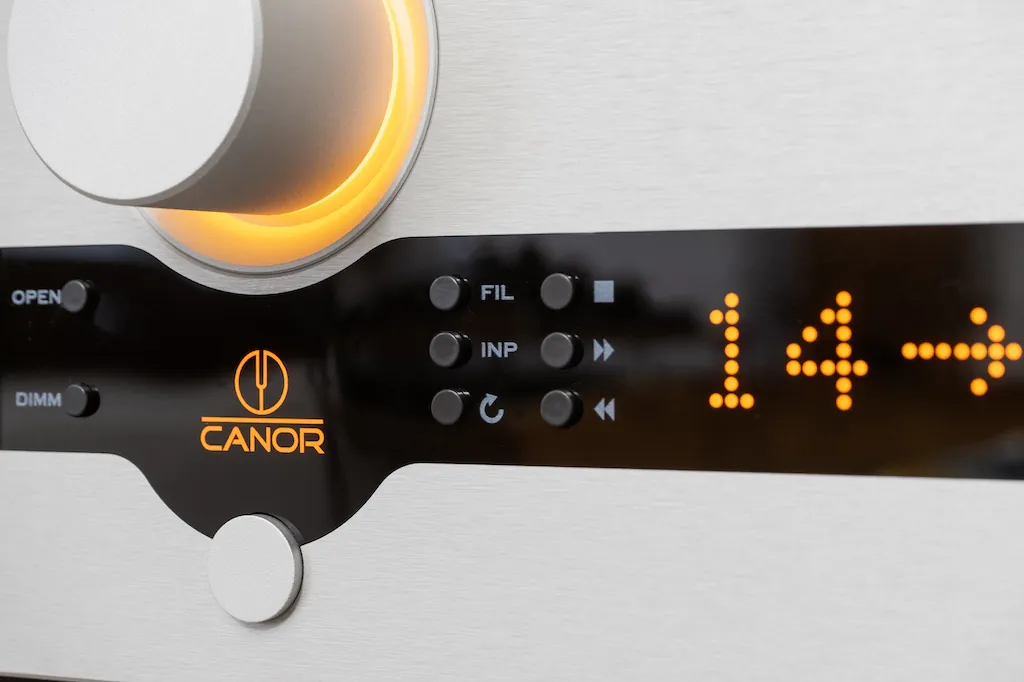
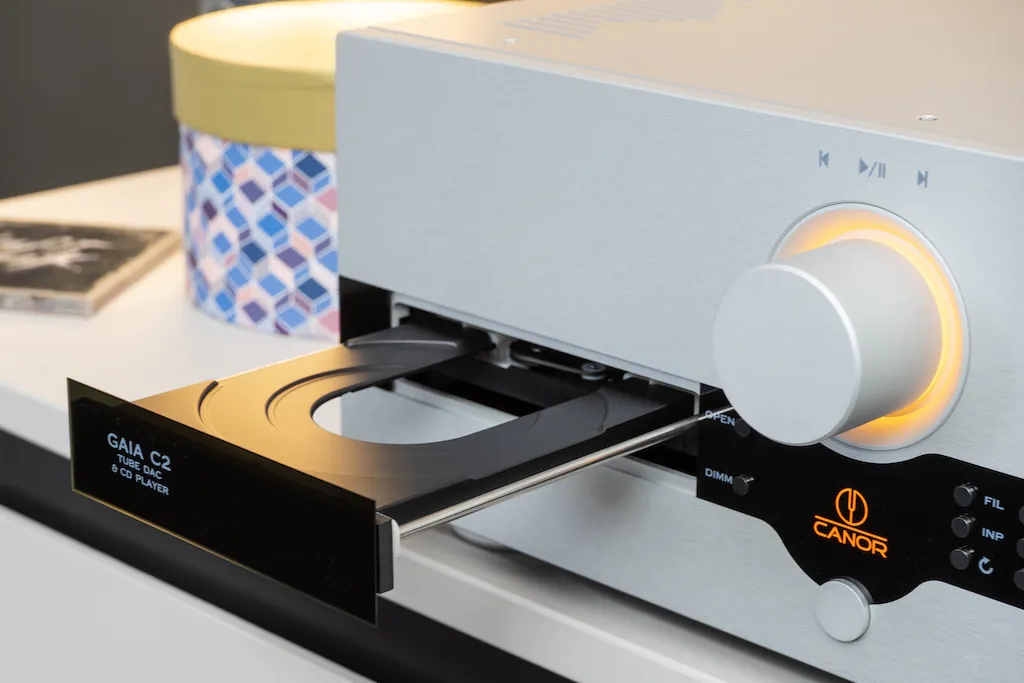
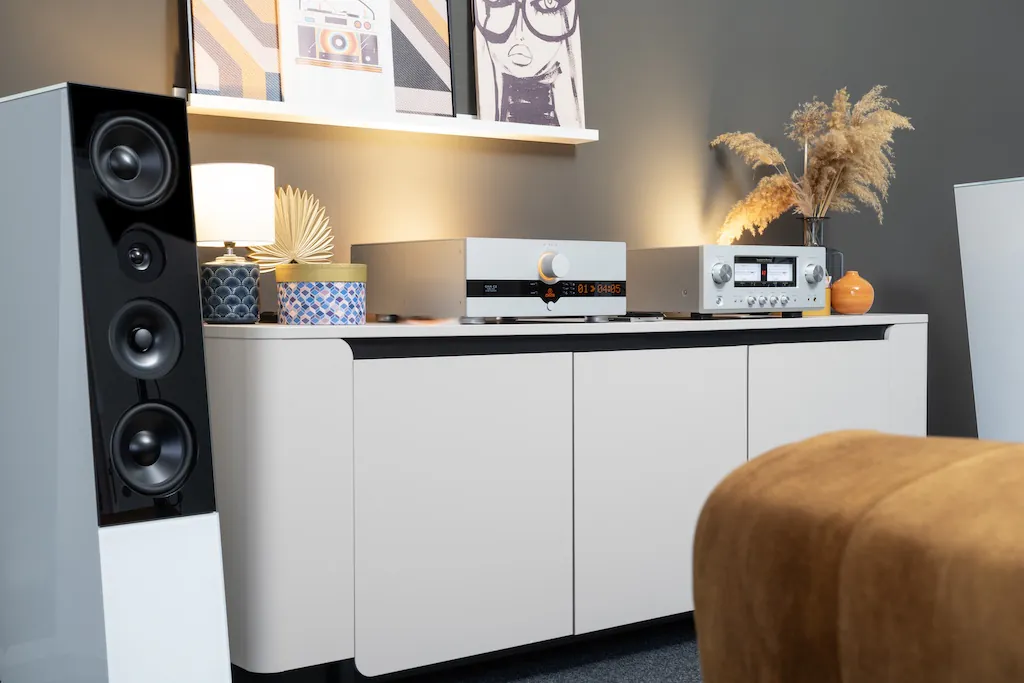
As a relatively young hi-fi brand, whose origins date back to the 1990s, Canor – despite its focus on glowing tubes – avoids incorporating retro elements into its devices. The Gaia C2, for example, boasts a fantastic, modern design that clearly underscores its technical sophistication, conveys a sense of high quality, and yet remains pleasingly approachable. The large rotary control is prominently featured. It sits almost centrally on the ten-millimeter-thick front panel, is mounted without screws, and is illuminated by a bright orange circular ring. A dark acrylic strip, within which the manufacturer’s logo also lights up, interrupts the monochrome silver or black of the anodized aluminum below, curving slightly around the large control element above. This dark strip also houses several function buttons, the CD tray on the left, and an orange-illuminated dot-matrix display on the right side of the front panel.
Homemade
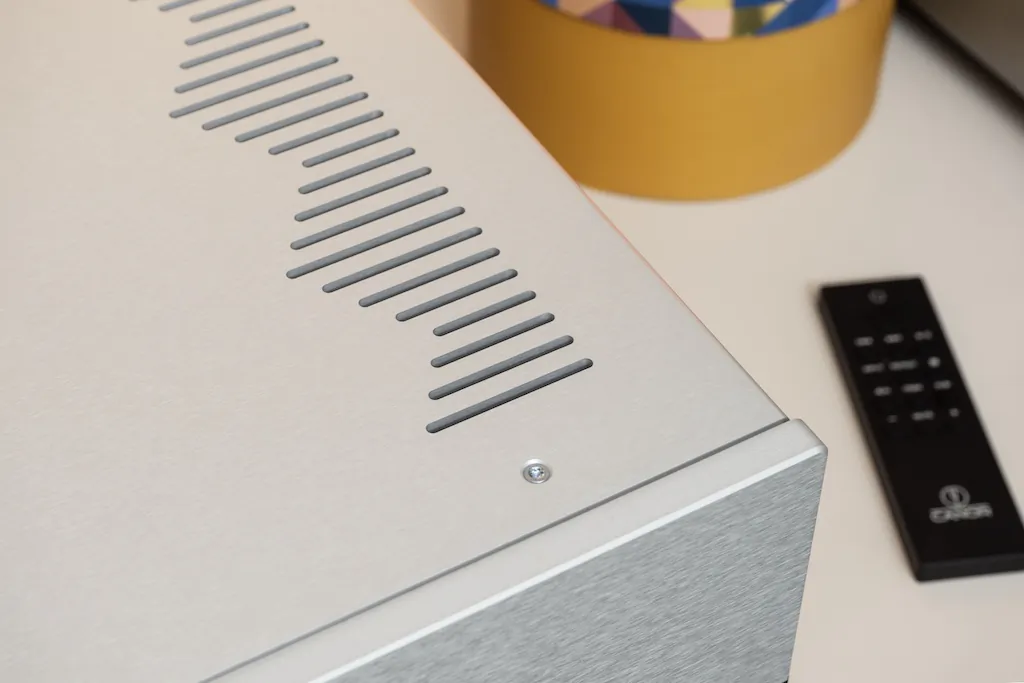
Canor has also opted for an elegant aesthetic in the rest of the housing. While the material thickness is slightly reduced here, its components are also manufactured and joined with great precision. Even the ventilation openings in the top panel, with their numerous individual slots of varying lengths, create a pleasing wave pattern. Here, too, the high manufacturing quality is evident, achieved through Canor’s in-house CNC milling machine. Even the surface finishing of the aluminum parts, such as sandblasting and anodizing, is carried out in a semi-automated production line built specifically for Canor in Prešov, Slovakia. The final inspection of the tubes is also performed there on three specialized machines according to stringent criteria. Finally, Canor even utilizes its own production and assembly line for its printed CMT circuit boards. The Gaia C2 thus employs a level of in-house expertise that far surpasses the standards of many other high-end audio manufacturers.
Tech treat
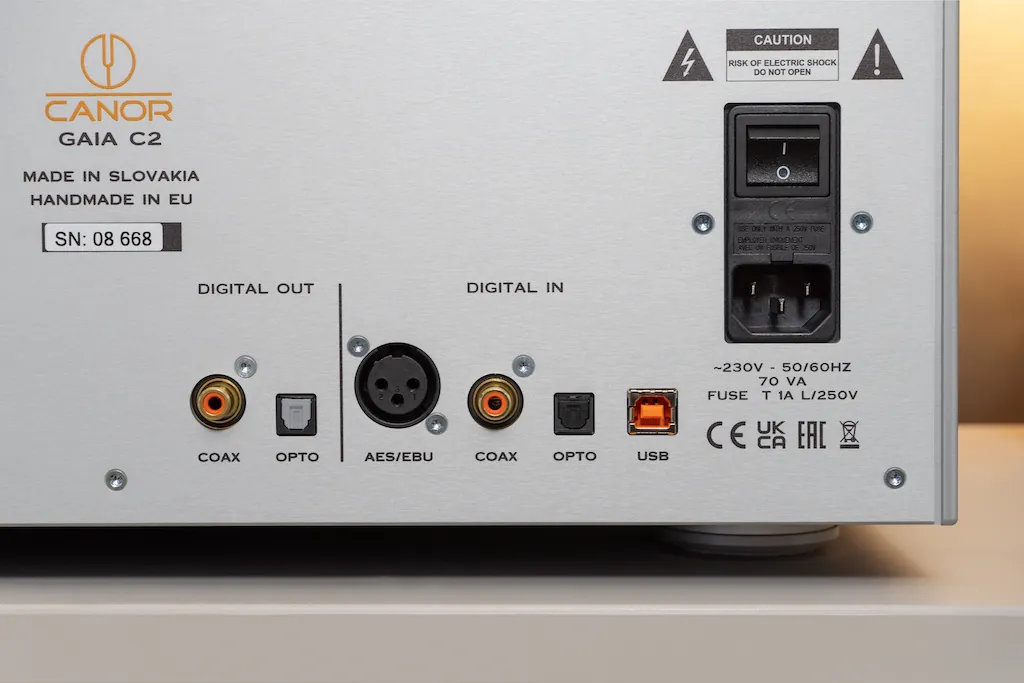
A look inside the DAC will also delight tech enthusiasts. All sections are housed on individual circuit boards, connected by neatly routed ribbon cables. A shielded transformer forms the core of the power supply, which already incorporates a 6CA4Eh tube. From there, power is distributed to the control board, CD drive, digital board, and the analog output stage. There, positioned directly before the output jacks, a pair of tubes per channel is used: an E88CC and a 12AX7LPS. The consistent separation of the two stereo channels begins in the digital section, where a dedicated DAC chip handles each channel. With the two Burr Brown PCM1792A chips, Canor has opted for a platform designed more for musicality than for cutting-edge high-resolution performance. For a device focused on natural sound, this is an excellent choice.
Filter fineness
In terms of specifications, the Gaia C2, with its Burr Brown Duo DAC, offers rather standard fare. For PCM formats like FLAC or WAV, 192 kHz at 24 bits is the maximum it supports. In principle, this is sufficient for more than 99 percent of the music available on the market, but technically, much more is possible today. However, the DAC doesn’t shy away from DSD and supports the bitstream format up to the DSD256 variant. Canor has also equipped the Gaia C2 with a filter selection. During playback, you can either use the default natural filter or switch to a “Dynamic” filter. This is selected using one of the buttons on the front panel, where you’ll also find buttons for playback control, lighting adjustment, input selection, and CD tray operation. Play/pause and track skipping are controlled with the large rotary knob.
More than discs
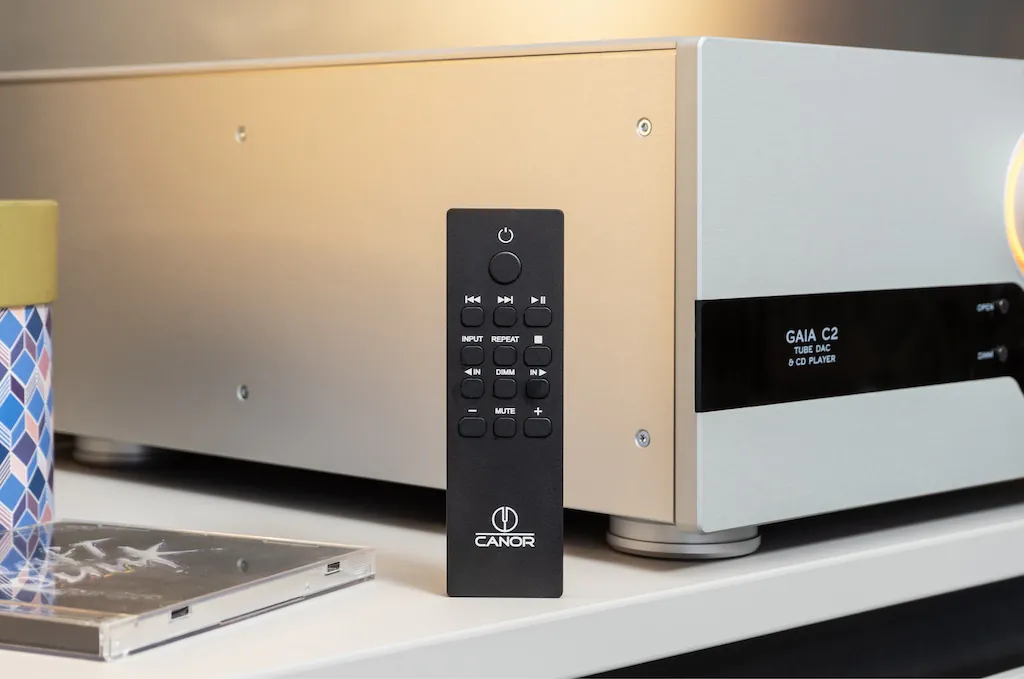
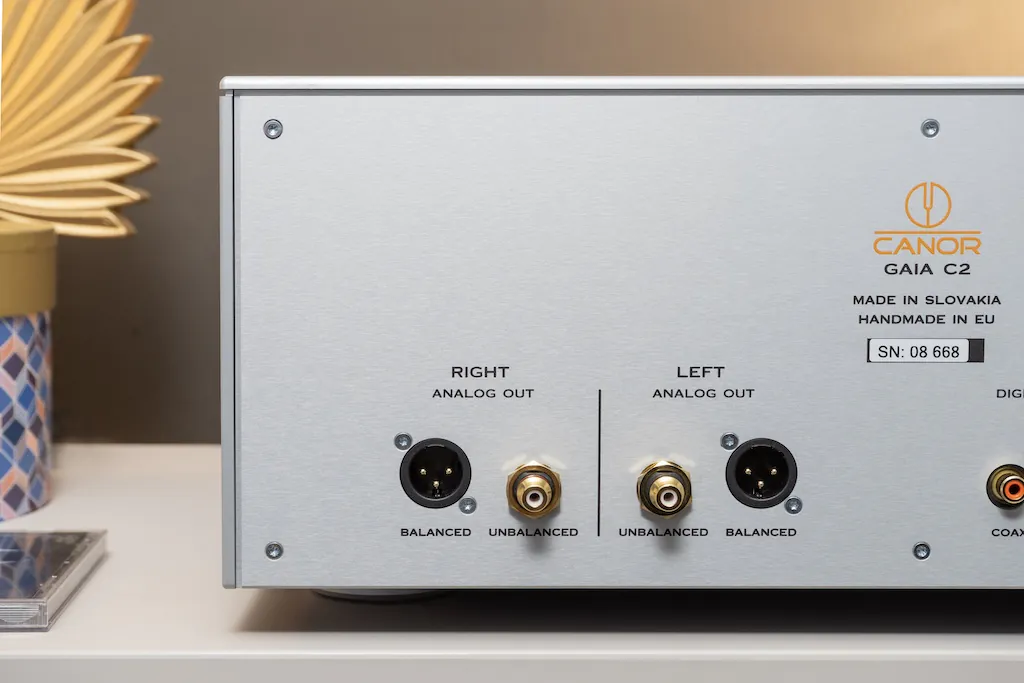
A small metal remote control is also included with the CD-DAC. However, not all buttons are functional, and not all functions, such as filter selection, can be controlled remotely. Changing the input, on the other hand, is no problem; at the touch of a button, the Gaia C2 switches to the next of its five different inputs. Besides the internal CD drive, there is a USB-B input on the back, which is particularly suitable for laptops, high-quality streaming players, or music servers. It is also the only connection on the device that supports DSD transmission. Alternatively, an AES/EBU input, a coaxial S/PDIF input, and an optical Toslink interface can be used. Preamplifiers and integrated amplifiers that receive converted signals from the DAC can then use either a pair of RCA jacks or the XLR output. Should you wish to bypass the internal DAC for any reason, an optical and a coaxial digital output are also available.
Canor Gaia C2 – Friend of the silver disc
We connected our Gaia C2 to an integrated amplifier and floorstanding speakers, as well as a Hi-Res streamer connected via USB. After switching on the device, Canor’s DAC first undergoes a short warm-up phase to bring the tubes up to temperature. Then, a brief press of the stop button on the remote control opens the CD tray. This is often a point of criticism, even with high-quality players, if the tray feels loose and unsupported. However, Canor reinforces its tray with two thin metal rods, so everything feels solid. Pressing the stop button again causes the tray to retract slowly, before the display shows the number of tracks and the total playing time in large, easily readable numbers. Pressing play starts playback, and the Gaia C2 can finally produce its first notes.
In the flow
Daft Punk’s “Discovery” plays over the laser, with the Gaia C2 initially setting up a large stage that is pleasingly positioned high up in the room and put to good use. The DAC then surprises with an unexpectedly multifaceted presentation of the bass range. The focus here is less on pure power and more on fine dynamics. At the same time, the bassline in “One More Time” has a nice physicality, seems defined, but attracts attention especially with its smooth flow. In “Aerodynamic,” the bass then descends far into the frequency basement, there is a little more power, but here, too, the casual flow of the beat is clearly preserved. The mid and high frequencies reveal the fine resolution of the drive and DAC. The bell chimes in the track in particular offer a rich fundamental tone and delicate overtones, while spreading out across the room.
Naturalness
Canor’s excellent understanding of space and how to utilize it is showcased in “Harder, Better, Faster, Stronger.” Here, it repeatedly brings elements to the forefront, pulls them back, or lets them dance across the soundstage from left to right. The foundation for the DAC’s beautiful spatiality is the very dark background, against which the music gains fantastic three-dimensionality. Everything sounds cleanly defined and differentiated. The performance is powerful, dynamic, and always controlled. Even with CD playback—despite electronic music—the aforementioned naturalness of the device is already evident. The Gaia C2 exudes a certain serenity, sounding rather silky and analog, without allowing its fairly neutral tonality to drift towards warmth. Musical flow is the focus here, rather than a hard-hitting attack. However, the CD DAC doesn’t lack punch.
Quick change
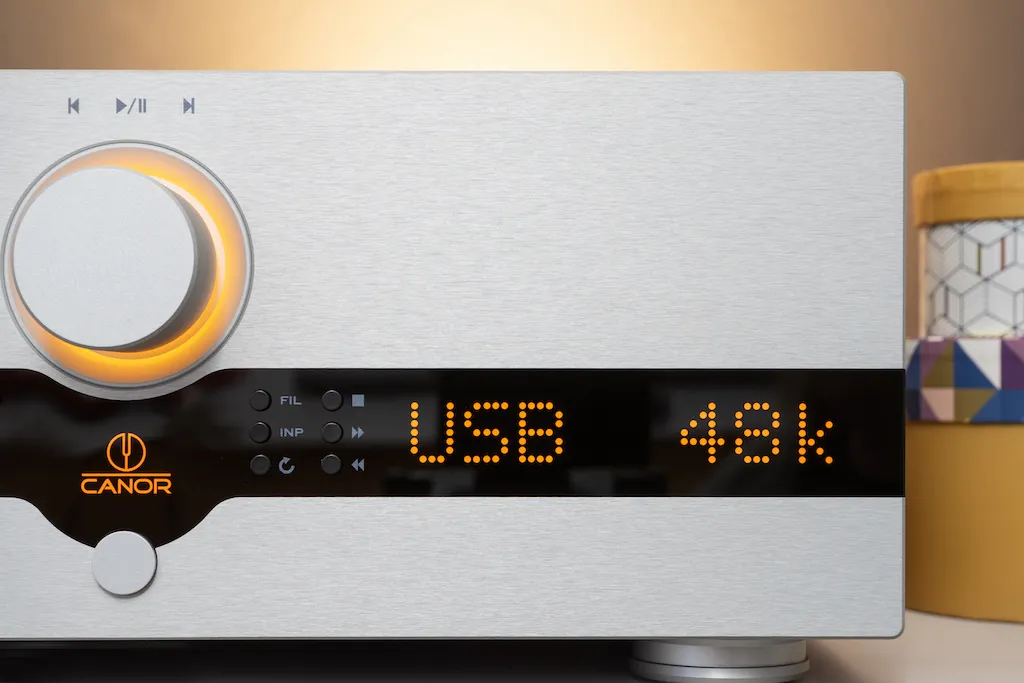
The DAC’s responsiveness to remote control inputs is also commendable. Skipping tracks is almost instantaneous, and fast-forwarding and rewinding are equally smooth. The track is also briefly played every few seconds, providing more than just the time display as a reference point. After the CD, the Gaia C2 switches to the USB input and the connected streamer, where “Cirklar” by the Tingvall Trio is added to the playlist. The display then changes to show the source and the sampling rate. The DAC’s sonic character remains consistent, once again delivering excellent depth and spaciousness. The piano, in particular, presents a full, rich sound, complemented by the punchy drums and crisp cymbals, which are dynamically projected into the soundstage. The bass drum, especially, sounds noticeably tight and powerful.
Expertise in classical music
The double bass completes the trio with a full, rich, and flowing sound, though the occasional slight buzzing of the strings against the instrument’s neck is not lost on the listener. The open playing style allows for this freedom while simultaneously making good use of the generously sized soundstage. The Gaia C2 then extends this space to the Czech Philharmonic Orchestra under the direction of Jiří Bělohlávek, performing Smetana’s “Má Vlast.” Here, the music practically envelops the listener as nimble flutes glide across the stage, brass instruments resonate powerfully from the depths, and silky-smooth violins, delicately plucked harps, and resonant timpani share the stage. In addition to the size of the orchestra, the transparency is also excellent, and above all, the transducer exhibits a natural, musical character that allows the listener to be wonderfully swept away.
Aesthete and headbanger
The Canor’s sound, especially with the “Dynamic” filter activated, is by no means limited to gentle jazz and orchestral classical music. The DAC renders Queens of the Stone Age’s “…Like Clockwork” with powerfully rich bass lines, underpinned by wonderful detail. The clear vocals take center stage, while Dave Grohl’s crisp drums are delivered with a fresh and punchy feel. The converter masterfully balances focused restraint with intense emotion. However, the excellent spatiality, detail, and dynamic range are also dependent on the recording quality. While it can deliver a powerful punch with well-mastered tracks, the Gaia C2 doesn’t quite forgive dynamic compression. Ariel Pocock’s HiRes cover of “Someone Like You,” however, clearly shines. Here, the DAC conjures up a delicate voice and combines it with gently plucked guitars and a vivid piano, creating a dreamy and relaxed display of its audiophile qualities.
Conclusion
The Canor Gaia C2 is a DAC that doesn’t overwhelm its listeners with brute dynamics and the most intricate details. Instead, it dedicates itself entirely to the music as a whole, focusing on naturalness and allowing its listeners to drift along with the flow of the music. It utilizes its tubes to deliver a perfectly balanced level of warmth without sacrificing precision or clarity. This is achieved both with CD playback and with the transmission of Hi-Res signals via its well-chosen connectivity options. Furthermore, its high-quality construction and appealing, modern design are sure to please. The Gaia C2 transforms digital data streams back into genuine music. It thus fully deserves the name of the mythological primordial mother of nature.
Test & Text: Philipp Schneckenburger
Photos: Simone Maier
Summary
- Overall rating: 99/100
- Class: Reference class
- Price/performance ratio: very good

Technical data
| Model | Canor Gaia C2 |
|---|---|
| Product category | DAC/CD player |
| Price | 6,749 euros |
| Guarantee | 2 years |
| Details |
|
| Distribution |
IDC Klaassen, Lünen 0231 22178822 www.canor-audio.de |
| Dimensions (H x W x D) | 170 x 435 x 420 mm |
| Weight | 18 kg |
| Entrances |
|
| Exits |
|
| Supported sampling rates |
PCM: up to 192 kHz / 24 bit DSD: up to DSD256, 11.2 MHz / 1 bit |
| Scope of delivery |
|
| Pros & Cons |
Pros:
Cons:
|
Grading
| Sound (60%) | 99/100 |
|---|---|
| Practice (20%) | 99/100 |
| Equipment (20%) | 99/100 |
| Overall grade | 99/100 |
| Class | Reference class |
| Price-performance | very good |
Tested with
| Innuos ZENmini Mk3 |
| Lumin P1 Mini |
| Audioquest Carbon USB |
| Audioquest Black Beauty XLR |
| Luxman L-505Z |
| Hegel H360 |
| Audio Physic Midex |