
- Home
- About us
- Blog
- Shop
- Brands
- ALL Brands List
- Analog Relax
- Antipodes Audio
- Audio Phase
- Audio Solutions
- AudioByte
- AudioCircle
- Audiomica Laboratory
- Canary Audio
- Canor Audio
- Chameleon Audio
- Dan D'agostino
- Eversolo
- Ferrum Audio
- Fezz Audio
- Glanz
- HiFiMAN
- HoloAudio
- LAB 12
- LAIV
- LampizatOr
- Magico
- Mega Acoustic
- Monrio Audio
- Origin Live
- Phasemation
- Pink Faun
- PLiXIR
- Qualiton
- Reed
- Remton
- Revival Audio
- Riviera Audio
- Rockna Audio
- Sbooster
- Shelter
- Sigma Acoustics
- Signal Projects
- SOtM Audio
- SPEC
- Takatsuki
- Takumi
- Tedeska
- Tellurium Q
- Trafomatic Audio
- Tsakiridis Devices
- Volumio
- Sales
- Second Hand Deals
- Account
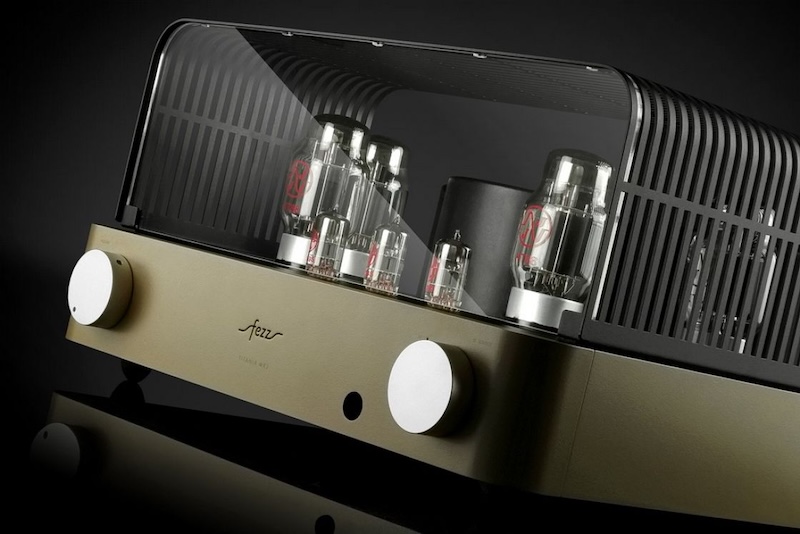
New Fezz Titania MkII Review Stereolife
Fezz Audio Titania MK2
In the world of audio equipment, it is not hard to find stories that sound compelling on paper, only to lose their charm the moment they collide with reality. Someone has an interesting idea, solid technical backing, a clear vision, even the right moment to enter the market, and yet after two or three years all that remains are a few mentions in the archives of specialist websites and a handful of products remembered by their owners with a certain fondness, but little real conviction. With Fezz Audio, things were different from the very beginning. Of course, one could look at the brand with caution, as it was entering an industry that loves a good new story on the one hand, but remains deeply conservative and distrustful on the other. When somebody appears on that scene with an original tube amplifier, many music lovers inevitably ask whether it really makes sense. Is this merely another attempt to offer something that looks familiar, glows in the dark and is meant to lure customers with promises of magical sound, without necessarily being backed up by a mature design?
In Fezz Audio’s case, that scepticism was understandable, but at the same time many music lovers overlooked one fact – this company did not emerge from nowhere. It was not the result of a sudden fashion for valves, nor an attempt to piece together an ‘own brand’ from ready-made parts bought wherever they happened to be cheapest at the time. From the outset, the entire project stood on the foundations of Toroidy, a family company that had been manufacturing transformers for years. And in the world of tube amplifiers, these are hardly a side issue or some component that can be mediocre because it does not affect the final result. For many designers, transformers are the heart of the entire circuit, its most expensive and most sonically significant element. Anyone capable of making truly good transformers has something far more valuable in hand than an eye-catching fascia or a good marketing slogan. They have a foundation on which a genuinely good amplifier can be built.
That is precisely why Fezz Audio’s first amplifiers attracted so much attention. They were simple, somewhat austere, far removed from the elegance and refinement of the company’s current products, but they made sense. They defended themselves with price, with a sensible philosophy and with the feeling that there were people behind them who actually knew what they were doing. Introduced in 2015, the Silver Luna arrived at exactly the right moment and addressed exactly the right needs. It showed that a Polish valve amplifier did not have to be an exotic curiosity, a garage experiment or an expensive whim for a narrow circle of initiates. More models followed, the scale of operations grew and eventually Fezz stopped being a brand spoken of with patriotic sympathy. It became a company taken seriously – not only in Poland, but internationally.
Titania played a special role in that journey. In its first incarnation, it was a natural development of the idea known from the Silver Luna. What we got was a more powerful integrated amplifier based on KT88 valves, with greater power reserves, a more mature character and a much wider margin for matching loudspeakers. It was not yet an amplifier designed to prove that Fezz could build high-end works of art. Rather, it was a very sensible model for someone wanting to enter the world of valves without the typical limitations of cheaper designs. Even then, Titania impressed by refusing to be a stereotypical valve amplifier at all costs. It did not turn every recording into a warm, fluffy spectacle for lovers of vocals, small jazz ensembles and lazy evening listening sessions. It had more energy, more dynamics and more normality about it. This was a valve amplifier for people who listen to a wide variety of music, have real expectations of their equipment and are looking for an integrated amp that is original, but also capable, versatile and possessed of enough potential to survive at least one change of source, loudspeakers and cables.
Now Titania MK2 returns, and although it would be easy to treat it as merely another version of a well-known model, in reality we are dealing with something much more interesting. Yes, there is continuity here. It is still a KT88-based integrated amplifier. It is still a design meant to combine valve musicality with high power and the sort of versatility often absent from weaker, cheaper constructions. The DNA of its predecessor is still there. At the same time, however, the new Titania is not simply the same familiar amplifier dressed in stylish new clothes. It is a model rebuilt and adapted to the brand’s current stage of development. What we get is not only styling that customers fell in love with at first sight, but also a new internal architecture, higher power, a more elaborate driver stage, a new bias control and protection system, remote control, a subwoofer output, standby mode, tube pre-heating and two slots for expansion cards. In other words, an amplifier that preserves the pragmatism and sense of the old Titania, yet already belongs to an entirely different era in Fezz’s history. Courtesy of the manufacturer, Titania MK2 was delivered to our office a few weeks ago. That gave us enough time to try it in a range of configurations, and we are publishing this review as the first magazine in the world.
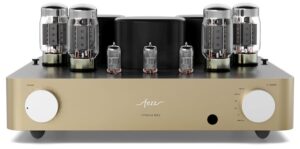
Like other Fezz Audio devices, the Titania MK2 is available in a variety of colors. You can choose not only from classic options like black or silver, but also from bolder ones such as burgundy, green, or gold.
Design and functionality
The most striking transformation Fezz has undergone in recent years obviously concerns design. The company’s older devices had their charm and one cannot deny them a certain authenticity. They were simple, honest, free from ornament and at times surprisingly austere. One could see the sincerity of a project subordinate to function and budget, but it would have been difficult to claim that stylistically they were ahead of the competition, or even that they were trying to enter into a more refined dialogue with it. They simply were what they were. Their form followed function, and that was the end of it. They were meant to convince the customer mainly with sound and price. The new Evolution series changed everything. Fezz’s collaboration with Kabo & Pydo turned out to be far more than a mere facelift. This is not a case of designers simply ‘drawing a prettier front panel’, adding a few elegant details and a revised logo. The entire visual language of the brand has changed. The new devices look like elements of a coherent, consciously built family. It is clear that someone approached the subject seriously and thought not only about aesthetics, but also ergonomics, proportions, the way the valves are displayed, the concealment of mounting screws, the logic of the visual accents and everything else that makes a device not only look good in a render, but also function properly in a living room and avoid becoming a nuisance in day-to-day use.
Titania MK2 is an excellent example of this new approach. The shape of the chassis alone makes a very good impression. There are plenty of straight lines and calm surfaces here, but no boredom. It is minimalist, but not ascetic. There is a sense of modernity, but without slipping into studio-like impersonality. The amplifier stands on tall, rounded feet made of soft rubber, which may not be spectacular in themselves, but they are simply sensible. The amp stands securely, looks fairly light despite its substantial mass, and there is none of the audiophile eccentricity of sharp spikes, pucks and other solutions that look wonderful in photographs but can drive a person mad at home. Here, by contrast, there is nothing one has to remember and nothing that demands excessive pampering. You can just pick the amplifier up with confidence and place it where you want it. The soft feet will not scratch even delicate furniture. It may seem like a small thing, but it is a revealing one. Fezz has evidently reached the point where it no longer needs to prove anything. It can simply do sensible things.
The front panel preserves the symmetry characteristic of the new Fezz models. Two large aluminium knobs are placed at the sides, with a discreetly illuminated logo between them and a barely visible model name beneath it. Everything is highly orderly and pleasing to the eye. This is not the kind of minimalist simplicity that commands respect but does not invite you to come closer. Titania MK2 looks like an object designed to be lived with, not merely admired through glass. Color also plays a major role. Fezz has long enjoyed playing with finishes, and that deserves recognition because the world of hi-fi still operates within a rather gloomy standard palette – black, silver, perhaps graphite, sometimes a dark steel shade. The Polish company, by contrast, consistently demonstrates that an amplifier does not have to hide from the world. It can underline the character of a room and please the eye with something more than mere correctness. The quality of the finish is so high that even the bolder versions do not look eccentric, only like a well-designed product that can be understated or expressive depending on the owner’s taste.
As with the Luna and Mira Ceti 300B, which I reviewed not long ago, the packaging of this Polish amplifier makes a fine impression from the outset. The inside of the rigid carton is laid out so logically that unboxing becomes a real pleasure. Every element has its place. The valves are labelled with numbers corresponding to the markings on the amplifier chassis, accessories are packed separately, the protective cage’s large transparent panel is wrapped in film, the amplifier itself rests in a soft drawstring bag, and the whole thing is surrounded by precisely cut pieces of shock-absorbing foam. In the box, one receives not only standard accessories such as the remote and power cable, but also cotton gloves. Assembling and starting the amplifier is trivially simple. You insert the tubes according to the markings, attach the transparent panel to the protective cage with two screws and that is essentially it. There is none of the usual anxiety about whether something has been set up correctly, whether one will have to reach for a multimeter straight away, or whether after an hour it will turn out that the bias needs to be corrected because one channel has drifted slightly. That, in essence, is the advantage modern Fezz amplifiers have over many classical valve designs that still cling to traditional rituals. The Polish company sees no need to cultivate them. Soft start, automatic bias adjustment, remote control – all of this can now be done relatively quickly and inexpensively, so why not make life easier for the customer? None of it has any negative effect on the sound and none of it robs us of the ‘magic of valves’. On the contrary – it can only help extend their lifespan.
At one point, I found myself wondering which other company offers valve amplifiers that are equally modern and equally trouble-free. Audio Research? Copland? Canor? Unison Research? To be honest, in the broad field of modernity – and yes, I know that using the word in the context of a valve amplifier sounds slightly at odds with the stereotype, but only apparently so – Fezz has overtaken even some of the most established competitors. I am not talking solely about design. What other valve amplifier offers fully functional remote control, automatic bias, a soft-start circuit, warning LEDs for potential power-valve issues, each valve monitored individually, plus two slots for expansion cards that let you equip the amplifier within minutes with, for example, a phono input, a DAC with two digital inputs or Bluetooth 5.0?
As with the Luna and Mira Ceti 300B, Titania MK2 clearly shows that the Polish maker has drawn conclusions from its own experience and from users’ expectations. In the original Titania, the lack of a remote control or valve cage could still be explained away by the purist nature of the design, budget limitations or simply the youth of the brand. Today, such excuses no longer wash. A customer spending serious money on an integrated valve amplifier has every right to expect not only good sound, but also convenience. Titania MK2 delivers exactly that. The remote is no afterthought. This is not some generic controller you want to hide in a drawer after first use. The manufacturer has clearly decided that if the remote is to be part of the package, it should suit the character of the device. In audio, such details very often reveal whether the whole thing has been thought through properly. The same applies to standby mode, soft start and the valve warm-up procedure. The amplifier goes calmly through its start-up sequence, gives the valves time to enter proper operating conditions and communicates the process to the user in a clear and elegant manner. Instead of wondering whether everything is working as it should, one simply waits a moment for the amplifier to do its thing. It sounds banal, but it is precisely such details that create the sense of dealing with a mature, well-developed product.
The valve cage itself is another important element. Once again, Fezz approached the matter pragmatically. If some customers are going to want protection anyway, it makes sense to design it from the outset as a sensible part of the whole. As a result, the ‘cage’ does not look like a foreign object but fits naturally into the body of the amplifier, allowing it to retain its character even in a more domestically friendly form. Fitting it is extremely simple – just slightly loosen the two exposed screws protruding from the chassis, slide the cage into place and lock it down. There is no need even to reach for a screwdriver or spanner. Since this is my third close encounter with a Fezz amplifier from the Evolution series, however, I will mention one small detail, even if I may be the only person who noticed it. I am referring to that large transparent panel and, more specifically, to keeping it clean. For a truly perfect effect, it needs to be wiped, or rather polished, on both sides, but that only works for a while. Even if one remembers not to touch it with one’s fingers, the plexiglass becomes statically charged and attracts dust. Wipe it too often and it may become scratched, so in practice one is left with optics cloths, anti-static foam and compressed air. Fortunately, the panel is easy to remove, so if something does happen to it, replacement should be simple and inexpensive.
The rear panel reveals another difference between the Fezz of old and the Fezz of today. In that respect, the original Titania was a classic, straightforward integrated amplifier. The new one represents a completely different level of technology and user awareness. It offers three RCA inputs, a direct power-amp input, a subwoofer output, speaker terminals with taps for 4 and 8 ohm loudspeakers, a ground-loop switch, a three-pin mains inlet with a voltage selector for 115 or 230 V, and two slots for FEBS expansion cards, short for Fezz Extension Board System. The latter is one of the most sensible ideas to have appeared recently in the brand’s designs. Instead of trying to cram everything imaginable into the amplifier from the start, the manufacturer gives the user a solid foundation and the possibility of expanding it later. Bluetooth, a DAC, an MM phono stage – all of these can be added when they are actually needed. No extra boxes, no tangle of cables, no replacing the whole amplifier just because a year later you suddenly want a turntable or a simple wireless connection. The presence of two slots is a small but very important distinction. In many amplifiers, modularity ends with a single slot, which means every decision forces the user to give something else up. Here, that problem disappears – you can think about the amplifier more long-term.
Fezz Audio is of course not the first hi-fi manufacturer to come up with such an idea, but in the world of valve amplifiers we have hardly seen it before, at least not on this scale. The Polish company has clearly stopped looking at its products as fixed forms that the customer buys once and for all in one immutable specification. It has begun treating them as platforms that can grow alongside the owner’s system. In a sense, this was forced by the company’s previous system of add-ons and options. Older Fezz amplifiers could also be ordered with remote control, HT input, subwoofer output, a protective cage or Bluetooth, but it was all handled through a simple configurator at the ordering stage. Each amplifier was therefore built to order in a specific colour and with a specific equipment set. Now most of those options are standard, while elements that may prove useful to one user but not another have been shifted into the FEBS system. I suspect this may also make future amplifier upgrades easier. Instead of selling a richly configured model and then paying again for a DAC and phono input, one can simply remove both modules and install them in the new amplifier.
Although three FEBS modules are currently available, more will no doubt appear in the future. Perhaps we will eventually see HDMI sockets in this form, or a better DAC with a USB input? In fact, one of these new cards was already fitted to the review sample. It was a balanced input module with XLR sockets. Just before this review went to press, an identical board with an additional RCA input also appeared. Will users who already have three such inputs really need a fourth? I do not know, but firstly, once you introduce a modular system, it has to be developed, and secondly, these cards will also fit future Fezz models or revised versions of existing ones, where adding another analogue input would not be a foolish idea at all. Installing an expansion module is remarkably easy. Undo two screws, remove the blanking plate, connect the ribbon cable to the card, slide it into place and tighten the screws again. Wonderfully simple. FEBS module prices are also quite reasonable. The MM phono stage, the DAC and the Bluetooth 5.0 module all cost the same – €299. That is roughly what one would pay for an external device doing the same job. The XLR module costs the same. To a degree this is justified because it is not merely a pair of sockets – there is also an unbalancing stage located right behind them – but in my view such a board should cost less than a phono stage or DAC. The additional RCA input module, meanwhile, is priced at €149. By the way, would it not be rather nice if audio manufacturers could agree on a standard and let us see a modular system like this across different brands? Just imagine it – buying a new Fezz and fitting it with a DAC from FiiO or iFi Audio, plus a phono stage from Rega or Pro-Ject. Or better still, taking one of those modules out of your previous amplifier and installing it in the new one. It may not be very realistic, but one can dream.
When comparing the old and new Titania on paper, the most obvious difference is output power. Forty-five watts versus 60 watts per channel is a substantial jump, especially considering that we are still dealing with an amplifier using four KT88 valves in a push-pull, class AB topology. Where did the additional 15 watts come from? The shortest answer is that the original Titania was essentially a Silver Luna on steroids. Although it produced slightly more power, not all the advantages of such a circuit were fully exploited. Titania MK2, by contrast, was designed from scratch, and only now has the potential of a quartet of KT88 beam tetrodes been used to the full. Since we are on practical matters, I should mention something the Polish company does not even make much of, even though it is very important from the user’s point of view. The standard version comes fitted with a full set of JJ Electronic valves chosen for their sound and high reliability. It is also worth noting that every such element is tested and measured by the manufacturer, with the parameters stored in a database. If something happens to one power valve during use – for example, it loses vacuum for some unknown reason, or you drop it while cleaning – Fezz Audio can identify and send you a precisely matching replacement based on your amplifier’s serial number. Replacing one faulty component rather than a full quartet can save a significant amount of money. And if you feel like experimenting with the sound, the company’s online store offers KT88s from brands such as Electro-Harmonix, Genalex Gold Lion, Mullard, Svetlana and PSVane in four different versions. There are also substitutes including 6550, KT90 and KT120. In Titania MK2’s preamplifier section, three 12AX7 double triodes, or ECC83s, are employed, and since this is such a popular and well-known valve type, Toroidy’s website lists no fewer than 20 different models to choose from. Hard to complain.
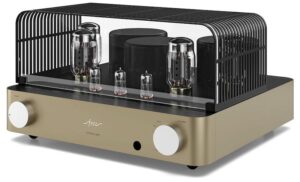
The tube cover has been designed so that the amplifier looks just as good – if not better – with it as without it.
Sound performance
After a dozen or so minutes of listening, one thought came to me quite clearly. Although we are dealing with an entirely different device – more modern, more attractive, more powerful and better than the original in every respect – Titania MK2 has not lost its identity. If I had to define in a single sentence what made the original Titania such a sensible proposition, I would say it was an amplifier for people who did not want a valve amp as an exotic accessory for occasional listening, but as the full-fledged centre of a normal, useful and ambitious stereo system. Not a device ‘for jazz’, not an amplifier ‘for vocals’, not a stylish toy for quiet noodling through speakers with the sensitivity figures of old horn brochures, but a proper integrated amplifier one could connect to most normal loudspeakers and use to listen to any music at all. The new Titania MK2 follows exactly the same path, only with greater confidence and maturity. What is more, within Fezz Audio’s current line-up it fulfils much the same role as its predecessor, though I will return to that point later.
From the very first minutes, it is obvious that we are dealing with a robust KT88-based design created to offer something more than stereotypical valve warmth. The sound is saturated, but not loose. Smooth, but not soft in any uncontrolled way. There is a touch of that characteristic valve nobility which gives vocals and acoustic instruments beautiful colour, air, greater plasticity and a more organic outline, but all of this happens without slipping into exaggeration. Titania MK2 does not try to create a world more beautiful than reality. It does not powder over recordings. It does not wrap them in a thick blanket. Rather, it tries to show that a valve amplifier can play evenly, honestly and even with real precision, without sacrificing its advantage over transistors in such areas as tone, saturation and the way it builds depth.
Perhaps most surprisingly, this is heard most clearly in the bass. The bottom end has long been what distinguished Titania from many valve amplifiers in a similar price bracket, and nothing has changed in that respect in the new version. If anything, one might even feel that the amplifier has gone a step further. The bass is strong, quick, decisive and very self-assured. There is no hesitation in its response, no fattening of notes for effect alone, no calming of the rhythm in the name of musicality. Bass guitar retains clarity even in dense, heavily compressed rock productions, double bass has the proper weight and spring, and electronic rumbles do not lose energy when they have to go really low and maintain order in the bottom octave. Of course, this is not transistor bass in the sense of brute hardness or a mercilessly contoured attack, but that is precisely why it is more interesting. Titania MK2 combines control with body. It gives the low end a meaty flavour, yet does not take away its shape or bite.
In the midrange, the new Fezz reveals the part of its character that many listeners will recognise immediately as valve-like, but again with restraint. Vocals sound close, natural and highly convincing in terms of timbre. They are not inflated, nor do they jump forward merely to prove to the listener that there are glowing glass bottles in the signal path – as if that could be forgotten with such an eye-catching amplifier in front of you. Instead, what we get is a midband with the right density and flow, yet still part of a larger, well-balanced whole. That matters because many valve amplifiers build their ‘magical sound’ on a few selected aspects of presentation, while neglecting everything else or comically fleeing from inconvenient subjects such as bass depth, transparency or dynamics. One is then supposed to focus on the warm, enchanting midrange, delicately polished treble and a stereo image with the front plane pushed distinctly towards the listener, but the moment one reaches for more demanding recordings or starts searching for those missing parts of the message, it becomes painfully clear that the emperor has no clothes. It is not even that the amplifier does worse in those areas – it often does not cope at all, dodging the difficult topics like a sulking child. Titania MK2 does not work like that. Here, the midrange is not the lone star of the show. It is more the centre of gravity around which everything else remains in healthy proportion. Thanks to that, acoustic instruments, strings, piano and the human voice have not only attractive color, but also proper weight and meaning in the wider musical context.
The treble is delivered in a very mature manner. There is no dullness, no recession and no artificial sharpening of transparency. Cymbals, background details, short decays and tiny artefacts are all clear, but never intrusive. The amplifier does not try at all costs to prove that it is fast and resolving. It simply does its job honestly. As a result, the top end retains sparkle and air without becoming detached from the rest of the band. This is very important, because treble is precisely where the balance between valve culture and modern definition is easiest to spoil. Fezz avoids that trap. The stereo imaging also deserves praise. The stage is not artificially bent out of shape to strengthen the impression that we are listening to something exceptional and eccentric. It is entirely normal, with proper proportions, and events are arranged in space in a convincing way. At the same time, it is clear that the amplifier has a lot to say in this area. It can produce a three-dimensional, involving sound, but it needs a reason to do so. This is not about spectacularly stretching the image far beyond the speaker boundaries or deepening every recording. Yes, if the recording allows it, Titania MK2 can present a truly three-dimensional soundstage, but its greatest strength here is order. Instruments and vocals are stable, the soundstage does not fall apart with more complex material, and the listener is not presented with chaos disguised beneath a layer of valve sweetness. Once again, this is a very grown-up approach to sound. The amplifier avoids cheap tricks. It prefers to build trust slowly, even at the risk that some listeners may be slightly underwhelmed in the first few minutes. That, incidentally, is one of the signs that we are dealing with a one-hundred-percent valve amplifier – it takes a little time to appreciate it fully.
The greatest compliment I can pay Titania MK2, however, is that in practice one does not feel the kind of tension so typical of many valve amplifiers when it comes to matching repertoire or loudspeakers. It never feels like a device that constantly needs to be petted, carefully matched and prayed over in the hope that it will not encounter a recording it cannot handle. Of course, like any amplifier, the Fezz has its own character and is not transparent, but that character does not consist in imposing whims on the system. It is much more about proposing a very sensible balance between valve culture and healthy, normal drive capability. It becomes especially obvious with more demanding music. Rock, dense electronic, highly demanding soundtracks, as well as speakers of lower sensitivity – you can steadily raise the level of difficulty and Titania MK2 does not begin to retreat or quietly announce surrender. Quite the opposite – that is when the logic of the design becomes even clearer, because the KT88s were not placed here to look dignified, but to deliver a solid dose of current to the loudspeakers. And with all that energy, the amplifier still retains its valve charm.
If you think about it, Titania MK2 repeats the formula used by the Polish company in the new Luna, only this time with more power and, let us be honest, with a sound that operates on a higher level in many respects. Here we have an amplifier that is not a stereotypical valve amp, yet does not lose the character and magic for which people in the 21st century still want equipment with glowing glass bottles in it at all. Listening to Titania MK2, one hears a touch of softness where it is needed. One hears richer texture. One hears more natural transitions, a pleasant sense of breath, a calmer, more fluid midrange and a space filled with that particular kind of plankton that transistor devices still cannot quite imitate. The point is that all of this has been built into a construction whose foundation is natural, well-balanced, full, honest and credible sound. All the elements of ‘valve magic’ are, in essence, additions – very important ones, creating a particular atmosphere, but still aware of their proper place in the hierarchy. They are not allowed to dominate, not allowed to dictate terms to the rest. Instead, they are there to complement an untouchable base best described with one simple word – normality.
That is exactly why the new Titania strikes me as a very versatile amplifier. It can be treated as a way into the serious world of valves, or bought as a destination integrated amplifier for a mature system of the upper mid-level or beyond. One can build around it a system focused on musicality, paired with speakers of calm and agreeable temperament, but one can also treat it as the centre of a modern, versatile audio setup complete with expansion modules, a subwoofer and a user experience more typical of transistor amplifiers. Titania MK2 makes sense in every one of those scenarios because it is not a device created for a narrow group of audiophiles, but rather for a broad range of listeners, both beginners and seasoned veterans. In the world of valve amplifiers, that is a great rarity, not to say something genuinely new.
For balance, I should mention the downsides, but although I have thought about them for several days, I can see only two, and both are, let us say, political in nature. The first is that Titania MK2 may seriously threaten at least two other Fezz models – the Luna and the Olympia. Spending €2,500 on a valve integrated amplifier, some customers will decide to add another fifty per cent to that sum in order to buy a more powerful, more versatile machine. On the other hand, those who had been leaning towards the Olympia may conclude that 60 rather than 100 watts per channel will be perfectly sufficient, that eight valves instead of four also means higher energy consumption and additional running costs, and that €2,200 is not a trivial difference. The second drawback is that Titania MK2 is a better amplifier than some people are likely to assume – whether on the basis of its price, or their own preconceptions and preferences. That, in turn, means that every investment in the surrounding system may pay off with doubled force. Yes, this little amplifier will sound excellent with the majority of loudspeakers on the market and with a decent source, but its potential goes much further. So do not be surprised if you bring in speaker systems costing three times as much as Titania MK2, a streamer worth twice as much, plus absurdly expensive cables and power accessories, and the amplifier not only refuses to wilt, but actually spreads its wings, as if to demonstrate that such a pairing is no mismatch at all.
So let this serve as a sincere warning to those who have always dreamt of a proper valve amplifier and think that a Fezz like this will be the final element in their system, the cherry on top. It will be, but it may also awaken the demon known as audiophilia nervosa. By fulfilling one dream, it will reveal the next. It will open new possibilities and sketch out new targets. Very few amplifiers at a sub-high-end price can do that, but this one certainly possesses that gift. In a sense, I fell victim to it myself, because I had no intention of investing in any equipment in the near future – not even cables or headphones – and I already own a large transistor power amplifier plus a decent 25-watt valve integrated amp. Yet now, with the review almost finished, I can hear a quiet voice at the back of my head suggesting that the amplifier described here could successfully replace both those devices, because it sounds wonderful and has power to spare. Strictly speaking, I would have to buy two of them, since we are talking about two systems in two different rooms, but then again… a Hegel H20 costs €5,995 and a Unison Research Triode 25 costs €4,299, which adds up to €10,294, so for that money I could buy not two, but three Titania MK2s. That in itself answers the question of whether Fezz’s latest amplifier is worth its asking price. And if you still have doubts, take a look at the prices of integrated valve amplifiers from established manufacturers offering 50 to 60 watts per channel, models such as the Ars-Sonum Gran Filarmonia XP Universum, Ayon Spirit V, BAT VK80i or Unison Research Performance. Even such a quick reconnaissance is enough to place Titania MK2 in the proper perspective and realise what a potentially huge hit it may become.
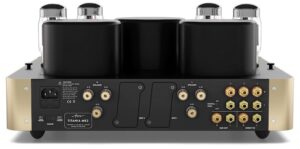
Such a rich feature set in a tube amplifier is a rarity. With two additional FEBS modules, it can serve as the true centerpiece of a modern stereo system.
Build quality and technical parameters
Fezz Audio Titania MK2 is an integrated valve amplifier operating in push-pull class AB. The output stage is based on four KT88 valves, while the driver and voltage stages employ three double-triode 12AX7s. That valve complement already says quite a lot about the character of the design. Compared with the previous Titania, the circuit has been expanded quite clearly. The use of a third 12AX7 is not a minor adjustment, but a sign that the manufacturer has redesigned the driver stage and the entire signal-path architecture more ambitiously than the outward appearance might suggest. The most important figure confirming this is output power. The previous Titania offered 45 watts per channel, whereas the MK2 version reaches 60 watts. That additional reserve means greater dynamic freedom, better tolerance of more difficult loads and a larger safety margin when driving more demanding loudspeakers.
As with every Fezz amplifier, the transformers remain a key element. This is neither an accident nor a company slogan, but the natural consequence of the brand’s origins. Backing from Toroidy means that the transformer section is not an outsourced add-on, but one of the foundations of the whole design. Titania MK2 uses proprietary output transformers in Supreme specification. Their role extends far beyond simply transferring power to the speakers. They are largely responsible for the amplifier’s ability to maintain wide bandwidth, good bass control and stable operation at higher signal levels. One of the most significant changes compared with the previous version concerns the management of valve operating parameters. In Titania MK2, the manufacturer has moved to an automatic analogue system of active bias control and adjustment, along with electronic protection circuits. From a technical perspective, this means not only easier operation, but also greater consistency of working conditions and better protection of the entire circuit. The user does not need to intervene in the settings of the output valves – the amplifier monitors and controls their operating parameters on its own. Added to that are a pre-heating procedure for the valves and a system for signalling possible irregularities. From a design-engineering perspective, this represents a move towards the modern valve amplifier – one that preserves classical audio architecture while limiting the typical operational weaknesses of the technology.
The mechanical side is equally important. The chassis is made of 2mm thick steel plate, and the amplifier as a whole weighs approximately 20.5 kg. That figure is entirely consistent with the device’s dimensions and the scale of its transformer section. Those dimensions are 420 mm in width, 380 mm in depth and 200 mm in height. This means Titania MK2 remains a compact design, but one built around a heavy, classical valve layout. The best proof of the quality of execution is what we see under the lid. Even in other recent Fezz models, the neatness of assembly and the orderliness of the internal architecture attracted attention. The number of wires has been reduced to a minimum, and the entire layout gives the impression of having been designed with considerable discipline. That matters because in valve equipment it is all too easy to hide assembly shortcomings behind the veil of tradition and hand-built craftsmanship. In this case, there is no such need. Titania MK2 looks like a device conceived from the start as a contemporary product. In terms of connections, the situation is clear and sensible. The user gets three RCA line inputs, a direct input for the power stage, a sub-out, speaker terminals for 4 and 8 ohm loads, and two FEBS expansion slots. The designers even thought to place the mains inlet as far as possible from the most interference-sensitive analogue inputs. I have no complaints.
As for the specifications, particular attention is drawn to the bandwidth declared by the manufacturer, extending from 16 Hz to 120 kHz within -3 dB. That is an excellent result, one that may be read as confirmation of the high quality of the toroidal transformers produced in the same factory. Harmonic distortion is kept below 0.05 per cent, which in the world of valve amplifiers also deserves recognition. Of course, figures alone will not tell us everything about the sonic character, but combined with the circuit topology and the chosen valve set, they create the picture of a design that is carefully developed and aimed at the most linear, stable operation possible. Input sensitivity is 0.7 V and input impedance 50 kOhm, which means the amplifier should pose no problems when used with typical analogue and digital sources. Power consumption is specified at 170 W at idle and 270 W at full power. These are entirely understandable values for an amplifier of this class, showing that we are dealing with an efficient construction, but not one with an excessive appetite for electricity. For comparison, the corresponding figures for the Olympia are 350 and 700 W, while Fezz’s flagship Magnetar Power Amplifier is rated at 440 and 1000 W.
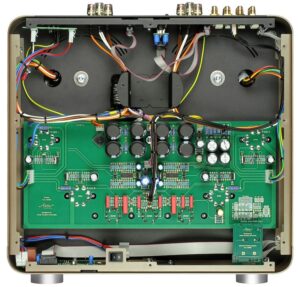
The interior looks extremely modern, almost like that of a transistor amplifier. The Polish company isn’t afraid of progressive solutions.
System configuration
Audiovector QR5, Equilibrium Nano, Unison Research Triode 25, Hegel H20, Auralic Aries G1, Auralic Vega G1, Marantz HD-DAC1, Clearaudio Concept, Cambridge Audio CP2, Cardas Clear Reflection, Tellurium Q Ultra Blue II, Albedo Geo, KBL Sound Red Corona, Enerr One 6S DCB, Enerr Tablette 6S, Enerr Transcenda Ultimate, Fidata HFU2, Melodika Purple Rain, Sennheiser HD 600, Beyerdynamic DT 990 PRO, Beyerdynamic DT 770 PRO, Meze 99 Classics, Bowers & Wilkins PX5, Pro-Ject Wallmount It 1, Custom Design RS 202, Silent Angel N8, Vicoustic VicWallpaper VMT, Vicoustic ViCloud VMT.
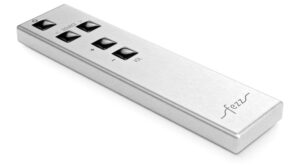
The remote control is not only attractive and made entirely of metal. It also supports all of the amplifier’s functions – volume control, source selection, and standby mode.
Verdict
Titania MK2 is one of those devices that best show where Fezz Audio stands today as a brand. No longer at the stage of being merely an interesting curiosity, an ambitious Polish maker trying to carve out its own slice of the pie, but in a place where one can speak of a manufacturer fully aware of its own identity. In this amplifier, one can see everything that has happened along the way – Toroidy’s experience, the success of the first models, the move into a more mature phase of design, the collaboration with a professional design studio, the ability to learn from customer feedback and day-to-day use of previous constructions, and the courage not to stop at the simple assumption that if something works, there is no need to touch it. This Podlasie-based manufacturer has already achieved a great deal, and yet it seems only to be gathering momentum. It invents, improves, expands, builds, hires, wins awards and keeps spreading its wings. Just before this review was published, it announced three new amplifiers and two new FEBS modules. What the coming years will bring – it’s hard to guess.
The most important thing, however, is that none of these layers has obscured Titania MK2’s basic mission. It remains an amplifier intended simply to sound good and to function well in a real stereo system. It does not pretend to be an esoteric work of art for initiates. Instead, it offers a mature, powerful and versatile interpretation of the valve amplifier, one that preserves the most important strengths of the technology while effectively limiting most of its typical weaknesses. Sonically, Titania MK2 impresses with its balance. It has valve culture, but is not sluggish. It has saturation and colour, but also excellent bass, dynamics, transparency and a very healthy attitude to the music it reproduces. It is not afraid of more demanding loudspeakers, heavier music or everyday normal use. There is no need to walk around it on tiptoe. The remote control, the rich connection set, the soft-start circuit, automatic bias, the protective cage, the two expansion slots and the popular, readily available valves – all of this makes the amplifier likeable not only for its sound, but also for its daily presence in the system. This is the sort of product that brings pleasure not only for the first fortnight, but also months later, when the novelty effect has long faded.
If I had to point to Titania MK2’s greatest strength, I would say it is its versatility, stemming from an absence of weak points. This amplifier does not rely on one strong accent to mask its shortcomings. Of course, one can always debate whether somebody might prefer more valve romance, a more romantic midrange or a heavier bass. But those would already be discussions about preference rather than the quality of the design itself. Perhaps that is why Titania MK2 strikes me as one of the most interesting, if not the most interesting, amplifier in Fezz’s current catalogue. What is more – and here we return to the thought from the beginning of the review – it does exactly what the original Titania managed to do ten years ago. That amplifier, though little more than a more powerful Silver Luna, was treated by some audiophiles as the ‘target’ model – the one that fulfilled all their expectations while still not costing a fortune. Even though the Polish company’s range now includes almost everything from small headphone amplifiers to flagship Magnetars, it is enough to compare Titania MK2 with its nearest stablemates – the Luna, Mira Ceti and Olympia – to realise that this is once again a perfect combination. If you feel that the Luna is slightly too small, the Mira Ceti too weak and the Olympia too expensive and unnecessarily complicated, you have now been given an offer that is very hard to refuse.