
- Home
- About us
- Blog
- Shop
- Brands
- ALL Brands List
- Analog Relax
- Antipodes Audio
- Audio Phase
- Audio Solutions
- AudioByte
- AudioCircle
- Audiomica Laboratory
- Canary Audio
- Canor Audio
- Chameleon Audio
- Dan D'agostino
- Eversolo
- Ferrum Audio
- Fezz Audio
- Glanz
- HiFiMAN
- HoloAudio
- LAB 12
- LAIV
- LampizatOr
- Magico
- Mega Acoustic
- Monrio Audio
- Origin Live
- Phasemation
- Pink Faun
- PLiXIR
- Qualiton
- Reed
- Remton
- Revival Audio
- Riviera Audio
- Rockna Audio
- Sbooster
- Shelter
- Sigma Acoustics
- Signal Projects
- SOtM Audio
- SPEC
- Takatsuki
- Takumi
- Tedeska
- Tellurium Q
- Trafomatic Audio
- Tsakiridis Devices
- Volumio
- Sales
- Second Hand Deals
- Account
New Fezz Luna Review – HIFIZONE PL
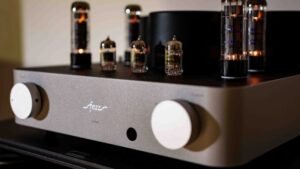
FEZZ Luna EVO is an integrated vaccum tube amplifier that is based on EL34 pentodes working in a push-pull configuration. It is both an extremely interesting and important design as well, especially when viewed in a broader context. This amplifier – introduced last (2025) year – replaces the well-known and popular Silver Luna model that was actually the first product from Fezz Audio. Moreover, according to the manufacturer, the new Luna is an amplifier that is devised entirely from the ground-up. Of course, some of the original concepts and well-proven ideas have remained in the new design. I am referring, for example, to the use of EL34 tubes in the power stage or the use of proprietary output transformers based on toroidal cores.
Nevertheless, the changes in the new model are significant enough that we are actually dealing with a completely new thing here. At the same time, the new Luna is also an amplifier that is supposed to offer a modern and even more refined version of tube technology in a truly user-friendly form. It is also supposed to provide significantly better sound than its predecessor by the virtue of several design solutions that are important from the sonic perspective. In other words, if we are to believe the manufacturer’s assurances, it has approached the new model, which refers to the moon in its name, with great reverence. This is not surprising, as Luna replaces Silver Luna, the model that – many years ago – started it all.
Before we move on, let us go back in time a little and look closer at a certain context, including the historical one. Because this context is of extreme importance, especially when looking at the new model that is the subject of the review here. FEZZ is a domestic and family-owned brand, which was established on the basis of company called Toroidy.pl. The latter manufacturer is, in turn, very well known in the audio industry. And not only on our local market, but also – and perhaps above all – beyond our borders. The reason for this is very simple indeed – the company from Białystok makes very good toroidal transformers dedicated for use in audio equipment. They are good enough (and often made to exact specifications, in special shielded versions) that they can often be found in very expensive and very recognisable, renowned hi-end apparatus.
Moving on to the FEZZ brand itself (whose name, by the way, has changed from “Fezz Audio” to “FEZZ” in 2022), the premiere of its first product took place over 10 years ago. It was the Silver Luna integrated amplifier, which was officially unveiled at the Warsaw’s Audio Video Show in 2015. Those were the days when Chinese tube amplifiers, whose workmanship at the time left much to be desired, ruled almost unchallenged here in our country. And then suddenly, out of the blue, a Polish manufacturer “jumped in” with an amplifier that was not only reasonably priced, but also really well-made. To make things even more interesting, it was also quite capable sonically. In 2016, Polish manufacturer presented another not-so-solid-state amplifier. This time it was the Titania model based on KT88 power tetrodes.
Just a bit later things got really interesting, because in 2018, not only did the Omega Lupi headphone amplifier appear on the market, but also the Mira Ceti model based on Single-Ended topology and the venerable 300B tubes. In addition, in 2019, Fezz Audio introduced a 2A3 tube-based version of the Mira Ceti and, also in the same year, a whole line of phono preamplifiers (Gaia Mini, Gaia, Gratia). Another extremely interesting design was introduced a year later, 2020 to be exact. It was the Lybra 300B model, which was still based on Single-Ended topology, but now using two 300B tubes per channel operating in parallel. And thus providing quite generous power capability, not to mention that at the same time Fezz Audio embarked on that not-so-long list of manufacturers offering PSE (Parallel Single-Ended) versions of their amplifiers.
Yet it was the 2022 that was a major breakthrough for the Polish brand. It was that year when the EVO line of devices saw the light of the day. They were the result of cooperation with the KABO&PYDO design studio and visually set things really apart. The EVO series initially offered several models of tube amplifiers and three models of preamplifiers (all mentioned above, in EVO versions). Shortly afterwards, the first Equinox DAC digital-to-analogue converter – designed in collaboration with the famous Lampizator brand – was introduced.
In 2024, the Sagita and Sagita Prestige tube preamplifiers were launched. I could go on and on hehe, but let me just point out one thing. You don’t have to be an expert on the audio market to notice that the company from Białystok has come a long way and become a globally recognised brand. A great and palpable confirmation of this can be the recently introduced Magnetar and Supernova series that really sets the bar high. At the same time, the new Luna that we have on our hands here is no less important.
This amplifier currently (early 2026) costs 9,750 PLN (which translated to 2500 Euro). For that price, you get a remote control (that controls both volume and source selection – this is a standard in the new model), a protective basket for the tubes, a built-in preamplifier input and a subwoofer output. In other words, for around £2,000, you get a tube device made entirely in Poland, by a reputable and recognisable manufacturer that backs you up with their technical expertise. Even more, it is a device that uses many very modern and well-thought-out design solutions. These solutions should – just should – translate into two things. One would be obvious real-world functionality. And the other, possibly more importnt, would obviously be sonics. We will take a closer look at the new FEZZ’s contraption and see how things turn out…
FEZZ Luna – design and functionality
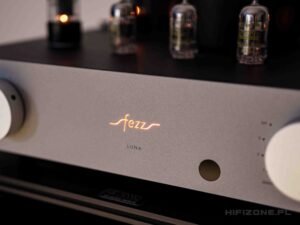
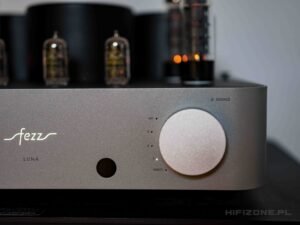
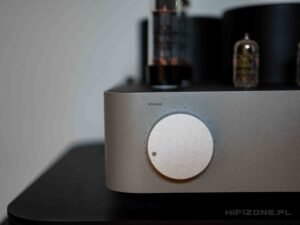
Let’s start with what is quite obvious and can be seen from the outside. The design of this amplifier is generally similar to the Silver Luna model that it replaces. It is also identical to all devices in the previously mentioned EVO line. As I pointed out when discussing the Silver Luna amplifier and reviewing the Titania model, the appearance of the latest amplifier is the result of collaboration between FEZZ and the KABO&PYDO design studio. Of course, for many this will be a highly subjective matter, but the fact is that FEZZ amplifiers look both modern and should feel at home in various spaces.
Other thing is that you can simply see that these devices are not the result of chance and, from a visual point of view, they were created by a designer with a keen eye for the detail. As with many other FEZZ products, the new amplifier is available in several colours. The Moonlight versions was sent to us, but there are six other variants available. So much for the appearance, because the functionality and, above all, the design of the new amplifier are no less interesting. Starting with the former, let’s take a look at the rear panel of the new Luna.
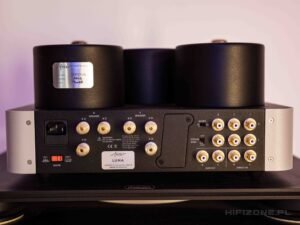
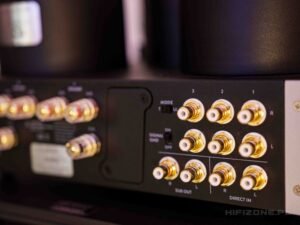
In addition to speaker terminals for two different speaker impedances, we can also find a rather interesting array of both inputs and outputs. While the number of line inputs is perhaps a bit modest, we also have a direct input for a power amplifier and an output – to make things more interesting, a stereo one – for a subwoofer (or actually subwoofers). So, if someone wanted (which is, contrary to popular belief, quite justified) to connect two subwoofers directly to the Luna, this is definitely possible. There are two switches on the rear panel too. One is used to “raise” the ground and will be useful in case of humming noises. And the other is used to select the operating mode of the amplifier itself. Let me get back to this a bit later, since now I would like to return to the whole concept of the amplifier itself. The new Luna belongs to the latest series, which is best described by Mr. Jakub Korpacz from FEZZ:
“Fezz is introducing a new line of amplifiers to replace the existing EVO devices on a one-to-one basis. They are all equipped with a standardised set of new features, previously available at an additional cost or not at all. There is now power on/off, source selection and volume control via an IR remote control; expansion card slots, sold separately, allow users to equip their amplifiers as they see fit: with BT, phono preamp, DAC, XLR inputs or others. This transformation provided an opportunity to thoroughly redesign all amplifiers, essentially creating them from the ground-up and taking into account the lessons learned from 10 years of production. The philosophy behind the design of the new Luna circuit, but not only that one, was that: to create an amplifier with the most faithful sound reproduction possible, capturing the smallest micro-details and revealing the truth about music, without adding anything of its own.”
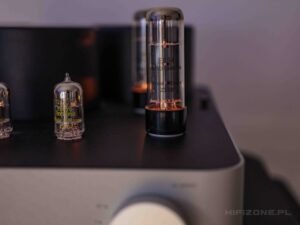
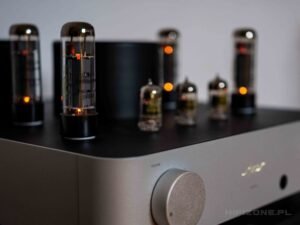
Particular attention should be paid here to the unified functionality of the new model, because now we can turn the amplifier on and off with the remote control. The more observant will also notice that, compared to the previous Silver Luna model, the new amplifier also has one tube more. This brings us to a very important and significant question, namely that the new model has a completely new electronic circuit, which:
“has been completely redesigned. An extensive cathode-coupled inverter has been used instead of the previously used split-load phase inverter. It provides approximately twice the amplitude of the drive voltage with a lower level of distortion. Due to the symmetry of this circuit, some of the distortion inevitably arising from the non-linearity of the tubes is simply compensated for, i.e. the distortion produced by one tube is balanced by that produced by the other one. It is a simple yet very elegant circuit, but one that requires the use of three tubes instead of two, so the number of pre-amp tubes had to be increased.”
The changes in the input and pre-amp circuits are not the only ones, as they also affect the output stages:
“The power amplifier part has also been modified – a triode-ultralinear switch has been added to change the operating mode of the power tubes, and the operating conditions of the amplifier have also been redesigned, mainly through the use of automatic quiescent current adjustment. In a nutshell, the cathode bias (so-called autobias) has been replaced by a fixed (manual) bias, but it is not regulated by the user, but by analogue automation, which monitors the currents flowing through the tubes and continuously adjusts the negative voltages applied to the grids. The elimination of cathode polarisation has many advantages, the most significant of which are increased power, reduced distortion and improved tube operating conditions. Now the tubes can operate at lower currents, so they are less stressed and should last longer. Moreover, as the tubes wear out, in a typical cathode bias circuit we would see a gradual decrease in current and, consequently, in output power. In the new Luna, the automatic system will set the correct current even with more worn-out tubes, which should allow you to squeeze the last drops out of them, with a quality not much worse than that of fully functional tubes. In short, it will allow for longer lifespan and a much later signs of tube wear.”
Please allow me to make an important comment here. The fact that automatic quiescent current regulation is used, and that it operates continuously, is really of utmost importance in this case. This is because fluctuations in these currents in audio amplifiers are a really big and often overlooked problem. They affect not only tube designs, but also transistor circuits, where after leaving the class A region of operation, there is an abrupt transition to class B mode. And that in turn leads a lot of problems, including (but not limited to) a phenomenon known as a GM doubling. The new Luna has an advanced system to protect against such bias changes:
“Luna uses analogue automatic quiescent current adjustment. The system consists of several stages: a current-voltage converter, an amplifier, an integrating circuit with a limiter, and a final amplifier that generates the appropriate negative voltage for the grid. This voltage changes and evolves as the tubes gradually wear out. The automation eagerly takes over from the user, who no longer has to adjust the bias with a multimeter and screwdriver, doing it for them, even more perfectly: more precisely and continuously. Even when the music is playing. This was the whole challenge – how to maintain a constant quiescent current in a class AB amplifier, where by definition the current varies depending on the drive? Suffice to say that between full drive and no input signal, the negative bias voltage does not change even by 1V.”
Another important thing should be mentioned here. That is the use of toroidal output transformers. FEZZ uses them in all of their vaccum tube amps. Worth mentioning is that the Polish company actually makes them on their own – after all, the brand was created by expanding Toroidy.pl to include a division dealing with the production of audio equipment. Mr Jakub Korpacz from FEZZ tells us about the advantages and general characteristics of toroidal transformers:
“The advantage of toroids over popular cores made of waste-free “EI” fittings stems largely from their optimal shape in terms of magnetic field lines – symmetrical, without protruding corners and holes, completely surrounded by windings. Toroidal core has another feature that distinguishes it from a core composed of a stack of laminations – it has no air gaps. A toroid tightly wound from anisotropic sheet metal is a monolith from the point of view of the field lines, which cannot be said about a core composed of laminations, even if assembled with the utmost care and precision. There are microscopic gaps between them, which constitute reluctance inserted into the magnetic circuit. This feature of the toroid is not an unambiguous advantage, or in other words: you have to know how to use it.
A transformer with micro air gaps (moulded), at the expense of lower achievable parameters, is much more forgiving. A few turns difference, carelessly wound winding halves, inaccurately selected power tubes or tubes that wear unevenly, poorly set quiescent current… all these things lead to a partial magnetisation of the core with direct current, which occurs much more gently in the presence of air gaps. And in the case of a toroidal magnetic core – almost instantly. A transformer with a saturated magnetic core has a drastically narrower frequency response and enormous distortion, reaching up to several dozen percent for the lowest registers of the audio spectrum.
Therefore, in order to fully benefit from the advantages of toroidal output transformers, there must be no asymmetry in the anode winding halves, and the currents must be completely identical, down to the milliamperes. Then such a transformer rewards you with parameters unattainable for other types of cores. And while winding asymmetry can be dealt with by simply winding them carefully, uneven tubes, especially those that wear unevenly, are difficult to combat. Only the proprietary analogue automation system used in LUNA, which continuously monitors and sets quiescent currents with an accuracy of tenths of a milliampere, completely solves this problem and allows you to fully enjoy the outstanding quality of toroidal output transformers.”
To sum up all of the above, what should be really emphasized is that the new LUNA sports many interesting and, above all, clever design solutions. To add to all of those, I’d like to mention that the delayed anode voltage switching has also been implemented. This allows the cathode in the tubes to reach its optimal emission temperature before high anode voltage appears. Such approach is not only very beneficial for the overall well-being and thus life-span of the tubes, but also ensures a much more stable start-up of the amplifier. The use of anti-vibration feet is also quite important, as they prevent the microphonic effect. In summary, LUNA is truly a world-class amplifier design, with several really well-thought-out solutions.
FEZZ Luna – sound
Please allow me to begin the description of the sound of the new Luna by mentioning a rather interesting correlation that often appears somewhat out of the blue in the world of audio. Whenever I receive a certain gear for a review that stands out with its a particular technology, I am often asked (usually by my friends) how much of that technology can be heard in the sound of that particular gear. This most often applies to tube amplifiers, where at some point someone will inevitably ask: “How much tubey is the sound?”.
However, tube amplifiers are not alone in this respect, as this can also be said of the recently popular digital-to-analogue converters based on various implementations of R2R architecture. Here, in turn, one often expects a sound that is somehow reminiscent of those TDA1541 or PCM63P ICs, or generally a sound that has “flow” and is organic in general. Why do I mention this? When people see a specific technical or circuit solution, they expect certain characteristics in the sound. Not only the positive ones, but they are also somehow biased to hear the appearance of those that are slightly less desirable. Obviously, there are quite a few tube amplifiers on the market that, strictly sonically speaking, clearly lean towards that typical (or rather stereotypical) tube sound. The new Luna is not such an amplifier. It is an amplifier that goes beyond most of those stereotypes that circulate around.
Of course, we will get to how much “tube in a tube” question just a bit later, but for now let me refer to something else. It’s worth asking one important question: whether this (or any other, be it solid-state Class A or whatever) particular amplification technology should strictly imply a specific sound aesthetic, or whether it should actually serve more to convey music as in its essence? I am bringing this up, since I must admit that I listened to the new Luna for a really long time, over a month in fact, and I find it difficult to resist the interesting impression that this amplifier is primarily playing and conveying music as it is. This is really important, since it somewhat pushes the “technological” considerations I mentioned earlier into the background.
Sure, you can hear that we are dealing with vaccum-state amplification here, but the effect is actually quite subtle, especially in triode mode (we will come to that later). The Luna does not colour the sound in a classic, stereotypical tube way. And certainly not as much as one would expect from an amplifier operating in push-pull mode, in class AB and with EL34 tubes. The first conclusion that can be drawn from longer listening sessions with a truly diverse repertoire is that the FEZZ Luna sounds, above all, extremely clean, subtle and undisturbed.
However, before we get down to specifics, allow to point out just two things. The description of the sound will refer to an amplifier playing on Electro-Harmonix tubes, in triode mode. As far as the tubes are concerned, that is the amplifier I received. As for the operating mode itself, of the two available, the triode mode sounds better (and I am assuming here that better means: “closer to the wire with gain”) overall, and that should come as no surprise to anyone. At the same time, the difference in power between the two modes (which is actually twice, ie. 20W in triode and 40W in UL mode) is not as significant in practice as it might seem. Or to put it another way: I will venture to make the bold claim that triode mode should be the default here, and UL mode should be an interesting addition, but still just that – an addition.
I started listening to Luna with electronic repertuire, namely the album “Inks” by AES Dana. It has that combination of synthetic, low bass impulses and a textured tonality. Already on the title track, the Luna showed that it do not only bass control, but it is also capable of generating a very evocative, close and tangible soundstage. At the same time, it was neither the soundstage nor the bass, but the ability to perfectly combine micro and macro dynamics that was most surprising on this particular album. Luna is exceptionally good at rendering that sonic plankton, all that micro-information that sometimes is lost, even with some tube amps. It is so good, in fact, that I reached for the “Celestial Echo” trach from the album “Convergence” by Malia and Boris Blank. Malia’s vocals in this were phenomenally rendered and placed in an airy space, considering the price of this amplifier.
The point here is that Luna has one feature that is rarely found in this price range. Please also consider this a very important advantage of this amplifier and a possible hint for anyone interested in this amplifier. On good recordings (especially those where the vocals were recorded with care), the new FEZZ amplifier does not add that extra haze that sometimes appears in some tube designs in this price range. Yes, you can hear that you are dealing with a tube, but you also get a very strong sense of directness in the sound.
This directness, and this should be viewed as another important point, is very similar to what you usually hear from good single-ended designs or solid-state amplifiers designed strictly for signal transparency (ie. Those usually low-power, high-bandwidth designs with low amount of output devices). Speaking in more absolute terms, the Polish amplifier brings the foreground a little closer and plays rather up-close. However, what it offers in the foreground, closer to the speaker line, is really very credible. At the same time, the new Luna does not try to present the listener with tube sound in the stereotypical sense of the word, but rather offers its tangibility and plasticity while maintaining both contour and dynamics.
FEZZ Luna is also one of those amplifiers that simply gets out of the way of the music. Or at least it really does everything to do so, bearing in mind its price. This was quite obvious once again on Portishead’s “Roads”, where Beth Gibbons’ voice was perfectly suspended in space. And at the same time, it was presented up close. And if I were to return to the topic of “tube in a tube”, now would be a good time to do so. It was precisely on a repertoire such as Portishead’s most famous album, or Morcheeba’s “Big Calm”, that you could hear the signal passing through vacuum components. Because when we look in absolute terms, Luna will, of course, play on the warm and more saturated side.
We have this additional element of musicality here, but it is also embellished and goes hand in hand with the amplifier’s very good grasp of all objective aspects of sound. The bass on Hans Zimmer’s “Why So Serious?” was being controlled and it had energy. Of course, large and expensive power amplifiers do those things on the lower end of spectrum better, but even in this track, Luna surprised us with how dynamic and lively everything sounded. What’s more, here too, the amplifier perfectly conveyed the atmosphere and energy of the recording. This brings us to another question – what is the difference between UL (Ultra Linear) mode and triode mode?
Let me put it this way: it’s still the same amplifier, but with a sound that leans just a little more towards a good pentode signature. Here, you can simply hear the sonic flair of the EL34 tubes, which is why so many people like it. At the same time, the amplifier still retains the characteristic clarity I mentioned earlier. The presentation in the UL mode is more expansive, the tone is more warmed up, and you can feel that the amplifier simply has more contour and its own character in this mode. The bass dynamics are also more spectacular. However, it is not as if there is a huge difference between these modes. And, of course, what someone will choose here will depend not only on their preferences, but also on the speakers and the rest of the playback chain.
FEZZ Luna – summary (and some interesting conclusions)
I will try to put it as short as viably possible. I knew this amplifier would be good, but I didn’t expect it to be that good. In fact, FEZZ has created something here that can easily be considered as a milestone. And I am not only referring to the extremely well-thought-out design of this amplifier, which is also really user-friendly at the same time. The new Luna also represents a new level in terms of sonic prowess. It is an amplifier that can be described without hesitation as a something of a long-distance competitor. Does it have any flaws? Considering the price, I don’t think so. However, for some, it may actually be too mild. Sometimes, these truly refined sound designs do not evoke really strong emotions at first. However, the longer you listen to the Luna, the more you simply appreciate its tuning. If any of you have around 2.5K Euro to spend on a good amplifier (and not necessarily looking for a tube one) please take a look at this new offering from a Polish company. It is rare for me to recommend a device with such fondness. Editor’s Choice Award.
Adam Kiryszewsk
New Luna is available for order now